
#computational chemistry
Every note tagged #computational chemistry, newest first — or browse the full archive.
Does a denser 90–105° same-geometry SF-TDA bracket keep the Hillel M4 sign change?
A 5° fill of this site's 2026-08-28 same-geometry two-root rematch of Hillel, Rough, Barrett, Pietro, and Mermut (2024) SF-TDA on 4-dimethylamino-4′-nitroazobenzene. The parent note's both-family sign change sat on a 15° 90–105° pair. This note narrows that pair with new constrained optimizations and same-geometry two-root single points at 95° and 100°.
Does the 2026-08-27 Hillel M4 SF profile-gap survive a same-geometry two-root rematch under Hillel 2024 SF-TDDFT?
An independent same-geometry two-root rematch of this site's 2026-08-27 Hillel M4 SF-TDA geometries at the Hillel, Rough, Barrett, Pietro, and Mermut (2024) electronic-structure level. The parent note's sign change was a separately relaxed profile gap. This note asks whether ΔE = E(T1)−E(S0) still changes sign when both roots come from one SF manifold on one structure.
Does Hillel M4 still show an S0/T1 crossing near 110° under Hillel 2024 SF-TDDFT?
An independent rematch of Hillel, Rough, Barrett, Pietro, and Mermut (2024) SF-TDDFT on 4-dimethylamino-4′-nitroazobenzene. The published 2026-08-22 RKS/UKS note found a both-converged S0/T1 sign change on this dye. This note asks whether that crossing remains when S0 and T1 are taken from the SF-TDDFT manifold at the 2024 electronic-structure level.
Does Johnson's invited CX3 rotation oscillate carboxylate oxygen charge more for CCl3 than for CF3?
An independent B3LYP-D3(BJ)/aug-cc-pVDZ rematch and relaxed CX3 rotation of CF3COO− and CCl3COO−, taking the geometry/bond-rotation invitation in Johnson et al. 2025. Binding charges are MBIS.
Does Hillel's 2024 push-pull sentence hold for 4-dimethylamino-4′-nitroazobenzene?
An independent RKS/UKS B3LYP-D3(BJ)/cc-pVDZ CNNC torsion scan of an untested 2024 generalization — that push-pull azobenzenes, like protonated AzPyH+, would lose the S0/T1 crossing along the azo twist. The test case is 4-dimethylamino-4′-nitroazobenzene, with azobenzene, AzPy, AzPyH+, and 2-phenylazopyridine as controls.
How the donor closes the gap: para-substituent effects in a minimal push-pull dye
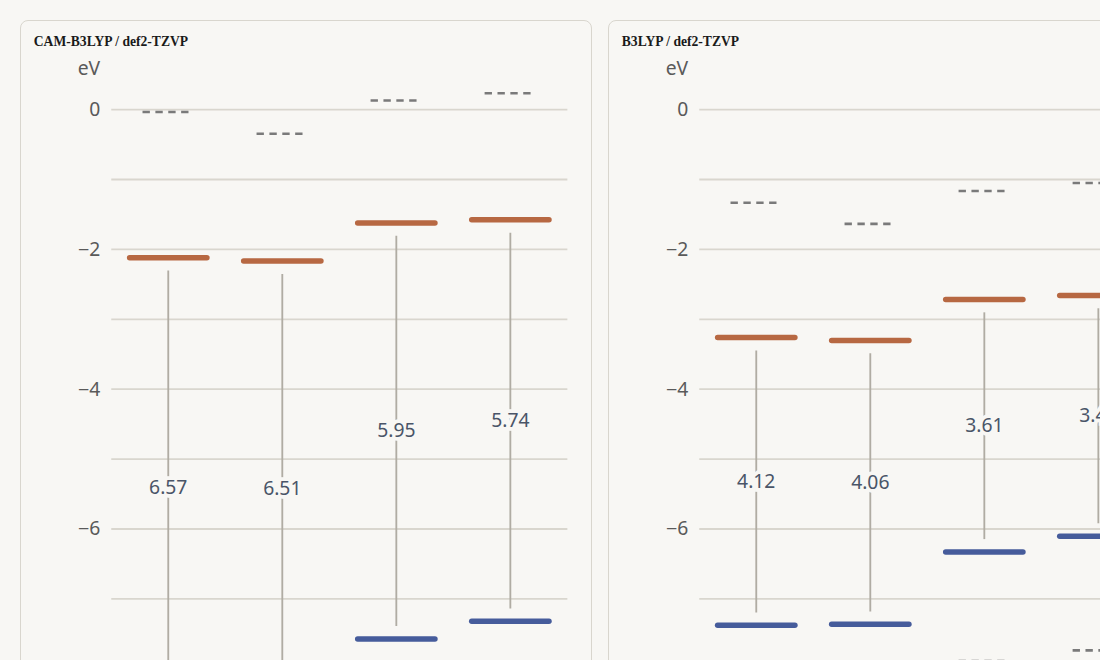
A four-point series of para-X-benzylidenemalononitriles (X = H, F, NH₂, NMe₂) shows how donor strength moves the HOMO and LUMO, and explains why para-fluorine acts as a weak net donor in this minimal push-pull scaffold.
How the acceptor closes the gap: acceptor-strength effects in para-methoxy push-pull dyes
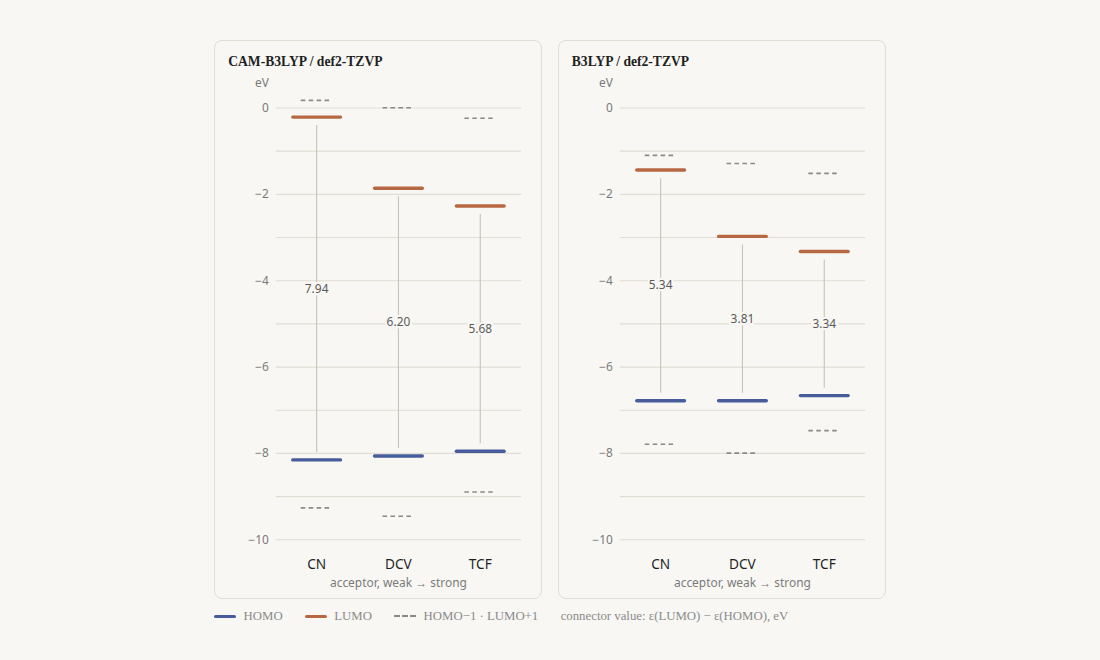
A three-point series of para-methoxy push-pull dyes with CN, DCV, and TCF acceptors shows how acceptor strength moves the HOMO and LUMO, and how the HOMO-LUMO gap closes as the acceptor strengthens.
One dye, one transition: how DCDHF-Me2 earns the two-level picture
The blinking-to-absorption note modeled a fluorescent dye as two levels and named what that hides. Computing the actual excited-state manifold of DCDHF-Me2 — a push-pull dye engineered for single-molecule imaging — gives a sharper answer than we planned. Its visible absorption is essentially one transition, and the rest of the manifold lives in the deep UV; benzene, the dye's own parent ring, shows the opposite arrangement for a reason symmetry makes plain.
Visualization of Compression Factor Behavior in Real Gases - A Virial Equation Approach
A computational exploration of how compression factors vary with temperature and pressure for common gases, demonstrating the transition between attractive and repulsive molecular interaction regimes.
Setting Up a Comprehensive Quantum Chemistry Environment on Linux
A detailed guide for establishing a versatile computational chemistry environment on Linux systems with instructions for package installation, environment configuration, and remote access setup.
AI Assisted Computational Tools for TDDFT Analysis of Chromophores Supplemental Information
A suite of Python-based computational tools for efficient geometry optimization, TD-DFT calculations, and spectral visualization of chromophores, providing a systematic approach to predicting electronic transitions and optical properties.
AI Assisted Computational Tools for Time-Dependent Density Functional Theory Analysis of Chromophores
A suite of Python-based computational tools for efficient geometry optimization, TD-DFT calculations, and spectral visualization of chromophores, providing a systematic approach to predicting electronic transitions and optical properties.
Comparative Analysis of TD-DFT Functionals for Formaldehyde Excited States
A systematic comparison of different DFT functionals for predicting formaldehyde excited states, revealing significant variations in excitation energies and oscillator strengths across methods.
Polarizability Trends in Carbon-Chalcogen Diatomic Molecules - A Computational Study
A systematic computational investigation of polarizability in diatomic molecules formed between carbon and Group 16 (O, S, Se, Te) elements, with analysis of geometry-optimized structures and higher-order electronic properties.
Polarizability Trends in Group 14-16 Heteronuclear Molecules - A Computational Study
A systematic computational investigation of polarizability trends in diatomic molecules formed between Group 14 (C, Si, Ge, Sn, Pb) and Group 16 (O, S, Se, Te) elements, showcasing the power of automation and open-source computational chemistry tools.
Mathematical Framework for Hyperpolarizability Calculations
A detailed explanation of the mathematical principles underlying hyperpolarizability calculations
Quantum Chemical Calculations of Hyperpolarizability - Setup and Initial Results
A detailed walkthrough of setting up computational environment for calculating hyperpolarizabilities of Group 4A elements
Calculating Atomic Polarizabilities of Group 14 Elements Using Psi4 - A Finite Field Approach
An experimental study calculating polarizabilities of Group 14 elements using Psi4's finite field method, with results for C, Si, and Ge, and insights into limitations for heavier elements.