
Does Hillel M4 still show an S0/T1 crossing near 110° under Hillel 2024 SF-TDDFT?
Abstract
Hillel, Rough, Barrett, Pietro, and Mermut (2024), in A cautionary tale of basic azo photoswitching in dichloromethane finally explained, computed 4-phenylazopyridine (AzPy) and its N-protonated form (AzPyH+) with spin-flip time-dependent density functional theory (SF-TDDFT, Tamm–Dancoff) at BH&HLYP-D3(BJ)/def2-QZVPP in ORCA and found that protonation removes the crossing between the electronic ground state (S0) and the lowest triplet (T1) along the azo CNNC twist.1 They wrote that this loss “would likely be observed for quaternized azopyridine derivatives and the wider class of push-pull azobenzenes.” That sentence was not a calculation on a classic NMe2/NO2 azobenzene.
This note is an independent rematch of that 2024 electronic-structure method on one molecule, 4-dimethylamino-4′-nitroazobenzene (M4). It is not a rebuttal of the 2024 paper or of Hillel, Barrett, Pietro, and Mermut (2026) on HPAS.2 A prior note on this site asked the same 2024 sentence at RKS/UKS B3LYP-D3(BJ)/cc-pVDZ; on that grid M4 has a both-converged S0/T1 sign change whose interpolant is 110.5° (published RKS/UKS note). The registered hypothesis here is that M4 still shows a both-converged S0/T1 crossing near 110° when S0 and T1 are taken from the SF-TDDFT manifold. In this experiment that means a sign change of separately relaxed SF-S0 and SF-T1 profiles, plus the interpolant of that profile gap — not an electronic gap at one molecular geometry, and not a minimum-energy crossing point.
The required window (135°, 120°, 105°, 90°) is both-converged and both-assigned at every point. The separately relaxed profile gap \(\Delta E = E(\mathrm{T1})-E(\mathrm{S0})\) changes sign between 90° (-19.10 kJ/mol) and 105° (13.14 kJ/mol). The linear interpolant of that profile gap is 98.89°. The 105°/120° pair does not change sign (13.14 and 57.22 kJ/mol). The registered hypothesis was supported.
Introduction
Azobenzene and its derivatives change shape around the N=N azo bond, from a trans isomer (the two rings opposite, CNNC dihedral 180°) toward a cis isomer (the rings on the same side, 0°). That torsion is the CNNC dihedral. Two electronic states sit on that path. The electronic ground state (S0) is the closed-shell singlet. The lowest triplet (T1) is the lowest state with two unpaired electrons of the same spin. Hillel et al. discuss a crossing as a geometry on the CNNC path where those two states have the same energy. The frozen experiment here is not that object. At each constrained CNNC angle the remaining coordinates were relaxed separately on the assigned SF-S0 surface and on the assigned SF-T1 surface. \(\Delta E\) is the gap between those two state-specific profiles at the same constrained φ. It is not two roots evaluated at one molecular geometry. In this note a crossing is operational: that profile gap \(\Delta E = E(\mathrm{T1})-E(\mathrm{S0})\) changes sign between neighbouring grid points that both converged and were both spin-assigned, plus that pair’s linear interpolant. It is not a minimum-energy crossing point.
Hillel, Rough, Barrett, Pietro, and Mermut computed AzPy and its N-protonated form AzPyH+ with SF-TDDFT (Tamm–Dancoff) at BH&HLYP-D3(BJ)/def2-QZVPP in ORCA and found that protonation removes that crossing.1 They wrote that the same loss “would likely be observed for quaternized azopyridine derivatives and the wider class of push-pull azobenzenes.” That sentence is a generalization, not a calculation on a classic NMe2/NO2 azobenzene. The same group later studied a different push-pull scaffold, the tautomerizable dye HPAS: SF-TDDFT was spin-contaminated near the twist, and a CASSCF/QD-NEVPT2 treatment of deprotonated HPAS found no S0/T1 crossing.2 It is not a scan of 4-dimethylamino-4′-nitroazobenzene, and it is not a rematch of the 2024 electronic-structure method on that dye.
A prior note on this site asked the 2024 sentence at a different level: RKS S0 and UKS T1 at B3LYP-D3(BJ)/cc-pVDZ. On that gas-phase 15° grid, M4 has a both-converged sign change whose interpolant is 110.5°, between 120° and 105° (published RKS/UKS note). That note did not run SF-TDDFT. The 2024 method, and the 110.5° zero, are therefore still an untested pairing.
The gap is that pairing. We could not find a published SF-TDDFT CNNC scan of 4-dimethylamino-4′-nitroazobenzene at the 2024 electronic-structure level. The hypothesis, frozen 2026-08-25 before the required window was scored and not rewritten afterward: M4 still shows a both-converged S0/T1 crossing near 110° when S0 and T1 are taken from the SF-TDDFT manifold. Three falsifiers were fixed at the same time. (1) \(\Delta E\) does not change sign on the required window. (2) The linear interpolant of a sign change lies outside 90–135°. (3) There is no neighbouring both-converged both-assigned pair from which an interpolant can be taken. Either outcome is publishable. A surviving in-window sign change of the separately relaxed profiles would mean the RKS/UKS 110.5° zero was not an artifact of leaving the 2024 method; a miss would bound that method on this dye.
Computational Methods
This is an independent implementation. The source authors’ geometries, orbitals, and energy tables were not imported. The run uses ORCA 6.1.1; Hillel et al. 2024 used ORCA 5.0.3.1,3 S0 and T1 are assigned from the SF-TDDFT manifold (Tamm–Dancoff) by \(\langle S^2\rangle\) and iroot. The functional, dispersion, and basis are LibXC(BHANDHLYP) with D3(BJ) and def2-QZVPP.4,5 The Coulomb fit is RIJCOSX. The CNNC dihedral was constrained and the remaining degrees of freedom were relaxed independently on each assigned surface. \(E(\mathrm{S0})\) is the assigned SF-S0 total after the S0-surface constrained optimization; \(E(\mathrm{T1})\) is the assigned SF-T1 total after the T1-surface constrained optimization. The remaining coordinates at a given φ are therefore not a shared molecular geometry. Both roots were not evaluated at one geometry. The required window is 135°, 120°, 105°, and 90°. The run is gas-phase; no polarizable continuum was applied. No minimum-energy crossing point was located. CASSCF/QD-NEVPT2 was not run. M2 was not reconverged. 4-hydroxyazobenzene was not started.
A point counts only if both assigned states converged and both were spin-assigned. A crossing here is a sign change of the separately relaxed SF-S0 and SF-T1 profile gap \(\Delta E = E(\mathrm{T1})-E(\mathrm{S0})\) on a neighbouring pair that meets that test, plus the linear interpolant of that pair. Conversion is 1 Eh = 2625.49963831 kJ/mol. The environment record is research/hillel-m4-sft/environment.md.
The protocol changed after the freeze, and those changes are dated in research/hillel-m4-sft/PREREGISTRATION.md. Native BH&HLYP constrained Opt exited 55; the published window uses LibXC(BHANDHLYP). The committed spin assignment uses a corrected read of the ORCA \(\langle S^2\rangle\) lines. S0 at 90° was reseeded from the converged T1 orbitals after the first S0 attempt. Jobs in the required window were paused and relocated; the published numbers are the both-converged both-assigned totals after those interruptions, not a second electronic-structure method. The hypothesis and the three falsifiers were not rewritten after the 90°/105° pair was seen.
Raw ORCA .out files stay in the private Molecules lab. They are large and carry host paths, and they are treated as scratch in the same way as the Hillel-triplet Psi4 logs. What is committed is the Bayes projection in research/hillel-m4-sft/results/bayes-metrics.json. The reproducibility label this directory has earned is analysis-reproducible. It is not end-to-end reproducible from this public repository.
Results
All four required CNNC points are both-converged and both-spin-assigned. Table 1 lists assigned SF-S0 and SF-T1 totals after the separately constrained optimizations of each surface.
Table 1. Assigned SF-S0 and SF-T1 totals on the required CNNC window after separately constrained optimizations of each assigned surface. \(\Delta E = E(\mathrm{T1})-E(\mathrm{S0})\) is the gap between those two profiles at the same constrained φ. LibXC(BHANDHLYP)-D3(BJ)/def2-QZVPP, SF-TDA, RIJCOSX, gas phase.
| CNNC (deg) | SF-S0 \(E\) (Eh) | SF-S0 \(\langle S^2\rangle\) | SF-S0 iroot | SF-T1 \(E\) (Eh) | SF-T1 \(\langle S^2\rangle\) | SF-T1 iroot | \(\Delta E\) (kJ/mol) |
|---|---|---|---|---|---|---|---|
| 135 | -911.038263125 | 0.140925 | 1 | -910.99856939 | 2.283123 | 2 | 104.22 |
| 120 | -911.02179347 | 0.167397 | 1 | -910.999998355 | 2.293241 | 2 | 57.22 |
| 105 | -911.005003805 | 0.240665 | 1 | -910.999997505 | 2.192470 | 2 | 13.14 |
| 90 | -910.991726666 | 0.306315 | 2 | -910.999002358 | 2.266676 | 1 | -19.10 |
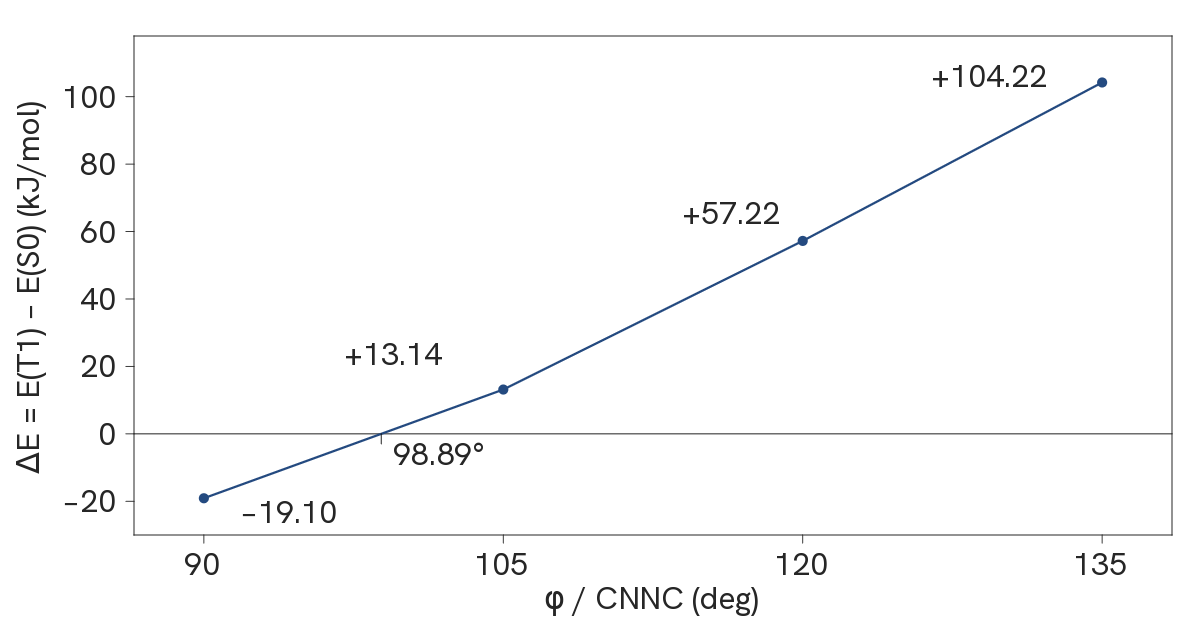
Figure 1. Separately relaxed SF-S0 and SF-T1 profile gap versus constrained CNNC angle φ. The four both-converged, both-assigned points from the Bayes metrics file (ORCA 6.1.1 SF-TDA, LibXC BHANDHLYP, D3BJ/def2-QZVPP) are labeled with their ΔE values: φ = 90°, ΔE = -19.10 kJ/mol; 105°, 13.14; 120°, 57.22; and 135°, 104.22, with ΔE = E(T1) − E(S0) after independent constrained optimizations of the two assigned surfaces. Adjacent both-converged neighbors are joined by straight segments. The 90–105 pair changes sign; 98.89° marks that pair’s linear interpolant at ΔE = 0. The 105–120 and 120–135 pairs stay positive and have no zero marker. 110° has no marker.
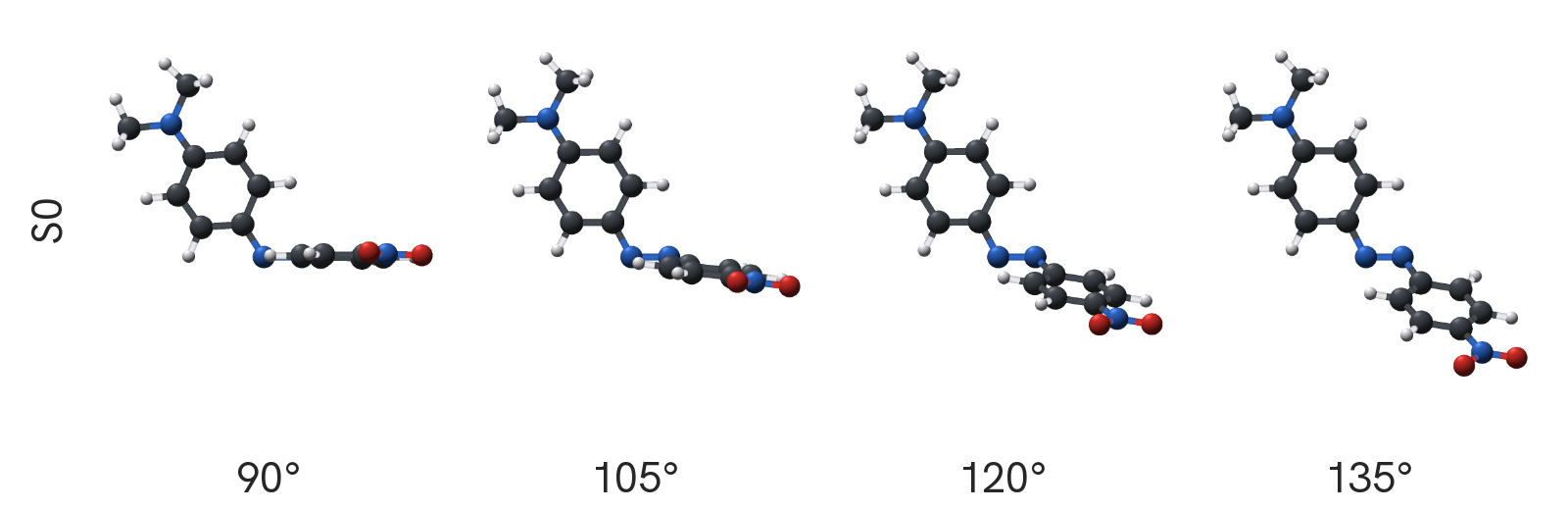
Figure 2. S0 stills of constrained-CNNC M4 at φ = 90°, 105°, 120°, and 135°, from a shared edge-on camera, with angle tags and no energies.
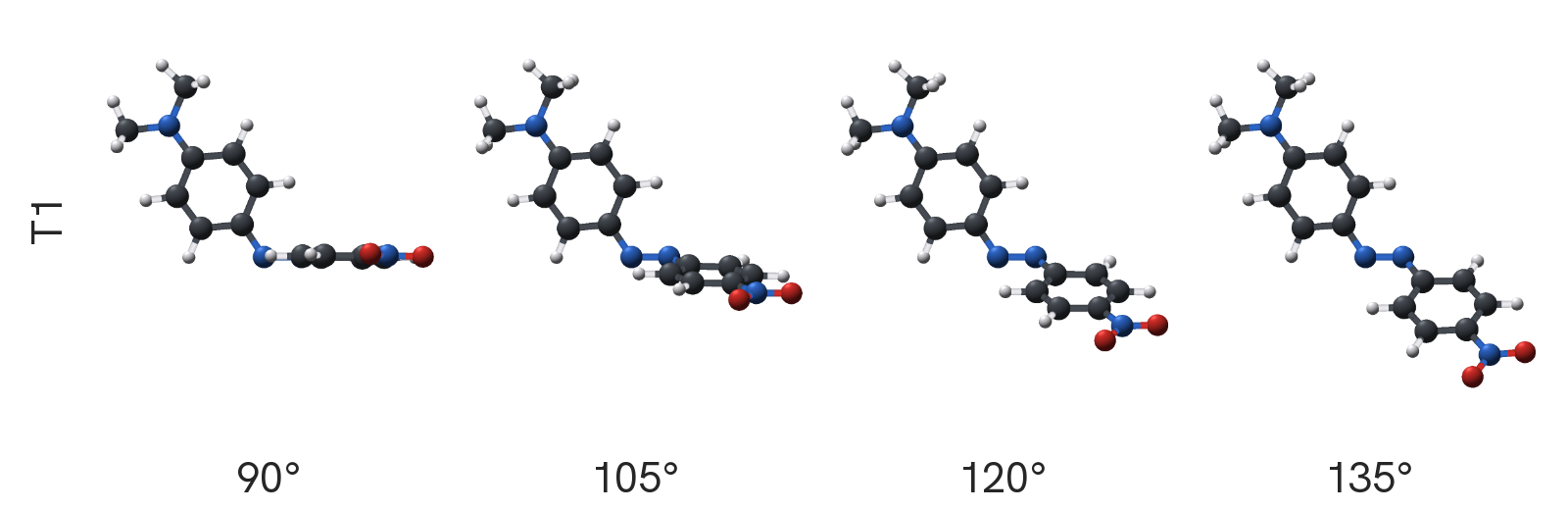
Figure 3. T1 stills of constrained-CNNC M4 at φ = 90°, 105°, 120°, and 135°, from the same shared edge-on camera, with angle tags and no energies.
The 90°/105° pair changes sign (Figure 1). The linear interpolant of that pair is 98.89°. The 105°/120° pair does not change sign (13.14 and 57.22 kJ/mol). The 120°/135° pair does not change sign (57.22 and 104.22 kJ/mol). Figure 2 is the S0-surface stills at those four φ values. Figure 3 is the T1-surface stills at the same angles, from the same edge-on camera.
Discussion
The registered hypothesis was supported. Falsifier 1 is false. Falsifier 2 is false. Falsifier 3 is false. The hypothesis-supported flag is true. M4 has a both-converged, both-assigned sign change of the separately relaxed SF-S0 and SF-T1 profiles between 90° and 105°, and the stored interpolant of that profile gap sits inside 90–135°. That interpolant is not an electronic gap at one molecular geometry, and it is not a located minimum-energy crossing point.
That is as far as the verdict goes. It is a verdict on our hypothesis and this window. It is not a statement that Hillel et al. were wrong, and it is not a rebuttal of the 2026 HPAS paper. The 2024 calculation is SF-TDDFT on AzPy and AzPyH+; the 2026 calculation is CASSCF/QD-NEVPT2 on a tautomerizable hydroxyquinoline azo dye after SF-TDDFT had failed; this calculation is SF-TDA LibXC(BHANDHLYP)-D3(BJ)/def2-QZVPP on 4-dimethylamino-4′-nitroazobenzene.1,2 Different scaffold in the source papers, same dye as the 2026-08-22 note, different electronic-structure level than that note. If a knowledgeable reader has already seen this profile-gap sign change on M4 at a comparable SF-TDDFT level, we would rather be told.
The B3LYP 120°/105° pair that decided the 2026-08-22 note does not change sign under SF (57.22 and 13.14 kJ/mol). The SF sign change is the 90°/105° pair. The interpolant of the profile gap therefore sits closer to 90° than the RKS/UKS 110.5° zero did. That is a movement of the profile-gap zero on a coarser, four-point window, not a second method on the same 15° grid.
The limits that would overturn or shrink this reading are mostly on our side. The published functional is LibXC(BHANDHLYP) after native Opt exit 55, not the native BH&HLYP keyword. The program is ORCA 6.1.1, not 5.0.3. The 90° S0 point was reseeded from T1. Jobs were paused and relocated. The committed \(\langle S^2\rangle\) assignment uses a corrected parser. The run is gas-phase; dichloromethane, the solvent of the 2024 experiments, is absent. We did not evaluate both roots at one molecular geometry, we did not locate a minimum-energy crossing point, and we did not run CASSCF/QD-NEVPT2 on M4. A solvent model, a native-functional repair, a same-geometry two-root evaluation, a located MECP, or a denser window could move or remove the 90°/105° profile-gap zero. That would be a different experiment, and we would treat a discrepancy as something to chase through our own setup first.
Conclusion
Under ORCA 6.1.1 SF-TDA LibXC(BHANDHLYP) D3BJ/def2-QZVPP (RIJCOSX, gas phase), the separately relaxed SF-S0 and SF-T1 profiles of constrained-CNNC M4 change sign between 90° (-19.10 kJ/mol) and 105° (13.14 kJ/mol). The linear interpolant of that profile gap is 98.89°, inside 90–135°. That interpolant is not a same-geometry electronic gap and is not a located MECP.
The next experiment is a same-geometry two-root SF evaluation at the four constrained-CNNC geometries already reported. At each of 90°, 105°, 120°, and 135°, take S0 and T1 from the same SF manifold on that one structure, and ask whether \(\Delta E = E(\mathrm{T1})-E(\mathrm{S0})\) still changes sign between 90° and 105°. A surviving sign change is an electronic gap at one geometry. A sign change that does not survive is a profile-gap only.