
Does Hillel's 2024 push-pull sentence hold for 4-dimethylamino-4′-nitroazobenzene?
Abstract
Hillel, Rough, Barrett, Pietro, and Mermut (2024), in A cautionary tale of basic azo photoswitching in dichloromethane finally explained, found that protonation of 4-phenylazopyridine removes the crossing between the electronic ground state (S0) and the lowest triplet (T1) along the azo CNNC twist — the geometry coordinate that takes the molecule from trans toward cis — and wrote that this “would likely” hold for the wider class of push-pull azobenzenes.1 The same group (Hillel, Barrett, Pietro, and Mermut, 2026, On the unexpected mechanism of isomerization in tautomerizable azo photoswitches) later reported no S0/T1 crossing on a different push-pull scaffold after SF-TDDFT failed and CASSCF/QD-NEVPT2 was used.2 This note is an independent constrained scan, at RKS/UKS B3LYP-D3(BJ)/cc-pVDZ, of that untested 2024 sentence: we ask whether a classic push-pull azobenzene (4-dimethylamino-4′-nitroazobenzene) still shows an S0/T1 crossing under our conditions, with azobenzene, AzPy, AzPyH+, and 2-phenylazopyridine as controls.
The registered hypothesis was that M4 would match protonated AzPyH+ (M2) and show no both-converged S0/T1 sign change on the 15° CNNC grid. The linear zero of \(E(\mathrm{S0})-E(\mathrm{T1})\) for M4 between the both-converged points at 120° (\(\Delta =\) -24.85 kJ/mol) and 105° (\(\Delta =\) 14.31 kJ/mol) sits at 110.5°. M2 has no both-converged crossing; its gaps at those same angles are -37.77 and -30.76 kJ/mol. The controls azobenzene, AzPy, and 2-AzPy each retain a trans-side crossing near 115–116°. The hypothesis was falsified under these conditions. That is a verdict on our hypothesis and this scan, not a grade on either Hillel paper.
Introduction
Azobenzene and its derivatives change shape around the N=N azo bond, from a trans isomer (the two rings opposite, CNNC dihedral 180°) toward a cis isomer (the rings on the same side, 0°). That torsion is the CNNC dihedral. Two electronic states sit on that path. The electronic ground state (S0) is the closed-shell singlet: all electrons paired, the state the molecule occupies at equilibrium. The lowest triplet (T1) is the lowest state with two unpaired electrons of the same spin (multiplicity three). A crossing is a geometry on the CNNC path where those two states have the same energy, \(E(\mathrm{S0})=E(\mathrm{T1})\). In this note that is operational: \(E(\mathrm{S0})-E(\mathrm{T1})\) changes sign between neighbouring grid points that both converged. If the surfaces meet, a thermally moving molecule can change spin at that geometry and continue on T1; if they never meet, that multistate rotation path is closed. On azobenzene itself, S0 and T1 are known to meet along the twist.3
Hillel, Rough, Barrett, Pietro, and Mermut computed AzPy and its N-protonated form AzPyH+ with SF-TDDFT and found that protonation removes that crossing.1 They attributed the change to an inductive weakening of the azo bond, and wrote that the same loss of the crossing “would likely be observed for quaternized azopyridine derivatives and the wider class of push-pull azobenzenes.” That sentence is a generalization, not a calculation on a push-pull azobenzene. The same group later studied a different push-pull scaffold, the tautomerizable dye HPAS: SF-TDDFT was spin-contaminated near the twist, and a CASSCF/QD-NEVPT2 treatment of deprotonated HPAS found no S0/T1 crossing.2 It is not a scan of 4-dimethylamino-4′-nitroazobenzene, and it is not a test of the 2024 sentence at a single-reference DFT level.
The gap is the 2024 sentence itself. We could not find a published CNNC scan of a classic donor–acceptor azobenzene — here 4-dimethylamino-4′-nitroazobenzene, the NMe2/NO2 dye labelled M4 — that asks whether that molecule still crosses under a transparent RKS/UKS protocol. The 2026 HPAS surface is the nearest published neighbour, and it is a different molecule treated with a different method after SF-TDDFT had already failed. That is the untested regime.
The hypothesis, written before the M4 T1 continuation finished and not rewritten afterward: if the 2024 generalization holds at this level of theory, M4 shows no S0/T1 crossing on the converged CNNC grid, like protonated AzPyH+ (M2). The falsifier, fixed at the same time: M4 shows an S0/T1 crossing between converged points. Either outcome is publishable. A missing crossing would be the first same-footing control we have for that sentence on this dye; a surviving crossing would mean the sentence did not hold under our conditions.
Computational Methods
This is an independent implementation. The source authors’ ORCA/SF-TDDFT program was not used, and none of their geometries, orbitals, or energy tables were imported. Psi4 1.11 has no SF-TDDFT in the build we used.4 S0 was computed restricted Kohn–Sham (RKS); T1 was unrestricted Kohn–Sham (UKS). The functional, dispersion, and basis are B3LYP-D3(BJ)/cc-pVDZ.5–8 The CNNC dihedral was frozen in optking and the remaining degrees of freedom were relaxed. Each surface is a continuation from trans (180°) toward cis (0°) in 15° steps. The run is gas-phase; no polarizable continuum was applied.
Five molecules share that protocol. M0 is azobenzene. M1 is
4-phenylazopyridine (AzPy). M2 is N-protonated AzPy (AzPyH+). M3 is
2-phenylazopyridine. M4 is 4-dimethylamino-4′-nitroazobenzene. Charge and
multiplicity are 1 1 / 1 3 for M2 and 0 1 / 0 3 for the others. The
canonical executable was
/opt/homebrew/Caskroom/miniforge/base/envs/qchem/bin/psi4 on local Apple
Silicon; the environment record is
research/hillel-triplet/environment.md. Default UKS output in this build
does not print \(\langle S^2\rangle\) (s2 is null). Near 90° the electronic
structure is expected to be multiconfigurational; Hillel et al. flag the
same single-reference limit, and so do we.1,2
A crossing is the linear zero of \(E(\mathrm{S0})-E(\mathrm{T1})\) on neighbouring points that both converged. Conversion is 1 Eh = 2625.4996 kJ/mol. Unconverged S0 energies are upper bounds: if those points later dropped, a still-negative gap would stay negative, and a positive gap built from an unconverged S0 would become less positive or change sign. That is why an unconverged point is not a crossing bracket.
The protocol changed once after the first surfaces were seen, and that
change is dated in research/hillel-triplet/PREREGISTRATION.md. M4 S0 at
90°, 75°, 60°, and 45° hit the 150-iteration cap. The remaining M4 S0
points at 30°, 15°, and 0° were not started. A reconvergence pass with
maxiter 300 was then run on 90°, 75°, and 60°. The hypothesis was not
changed after T1 was seen. On 2026-08-22, 60° reconverged
(\(E =\) -911.3231031736067 Eh). 90° remained unconverged, moving
-0.001 kJ/mol. 75° remained unconverged, dropped
3.61 kJ/mol, and kept a gap of
12.86 kJ/mol.
The private-lab journal records that M3 T1 at 45° failed. That slip is left in the record rather than repaired after the fact. M4 T1 converged at all 13 grid angles. S0 at 30°, 15°, and 0° was not run.
Raw Psi4 logs stay in the private Molecules lab. They are large and carry
host paths, and they are treated as scratch in the same way as the BMN
frontier-orbital logs. What is committed is the summary projection in
research/hillel-triplet/results/. The reproducibility label this directory
has earned is analysis-reproducible. It is not end-to-end reproducible
from this public repository.
Results
Table 1 lists both-converged crossings and the 120°/105° gaps that decide the claim. Table 2 lists the M4 relative energies from 180° through 45°. Figure 1 plots the M4 gap, the two M2 gaps at those angles, and the tabulated trans-side zeros. Figure 2 is the M4 S0 and T1 profiles. Figure 3 puts the M4 profiles beside the M4 and M2 gaps.
Table 1. Both-converged S0/T1 zeros and the 120°/105° gaps on the B3LYP-D3(BJ)/cc-pVDZ CNNC grid. A dash is a quantity that is not a both-converged neighbour zero in the committed projection. M1 has a loose interpolant at 76.5° that uses a 45° bracket: S0 at 90° and 75° did not converge. M3 T1 at 45° failed. M2 S0 did not converge at 180°, 90°, 75°, 60°, 45°, 30°, 15°, or 0°.
| Molecule | Trans-side crossing (deg) | Other both-converged zeros (deg) | \(\Delta\) at 120° (kJ/mol) | \(\Delta\) at 105° (kJ/mol) |
|---|---|---|---|---|
| M0 azobenzene | 115.5 | 65.6; also 27.8, 8.8 | — | — |
| M1 AzPy | 115.7 | — | — | — |
| M2 AzPyH+ | none (0) | — | -37.77 | -30.76 |
| M3 2-AzPy | 115.6 | 68.5 | — | — |
| M4 NMe2/NO2 | 110.5 | — | -24.85 | 14.31 |
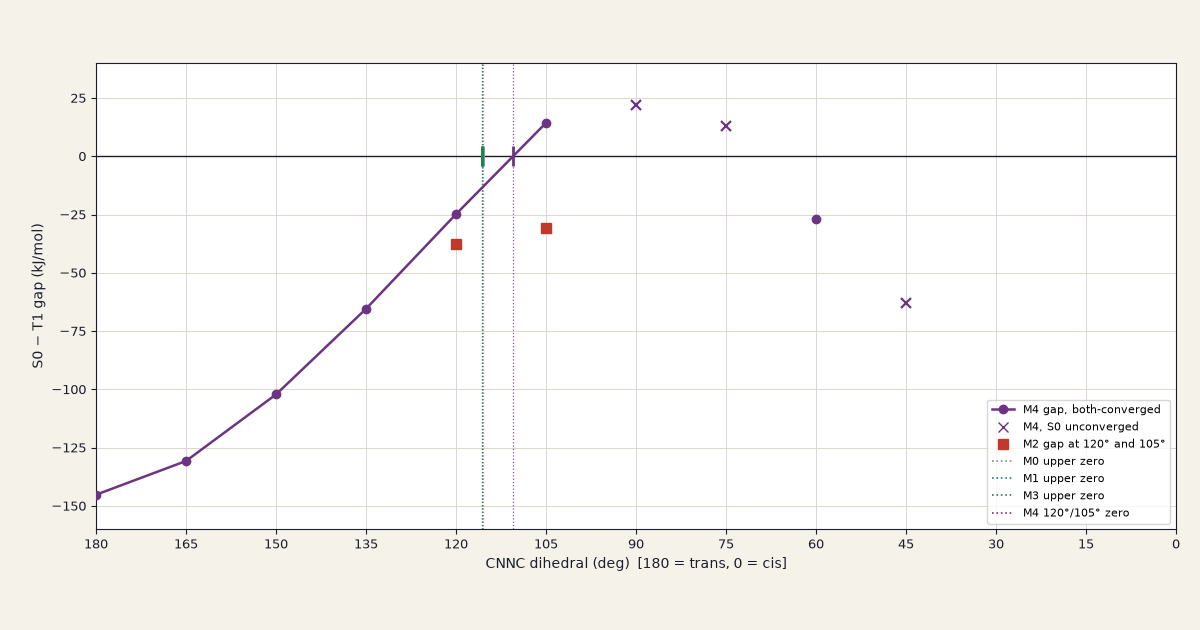
Figure 1. S0 − T1 gap versus CNNC dihedral for M4 (circles, both-converged; crosses, S0 unconverged), M2 at 120° and 105° (squares), and the tabulated trans-side zeros of M0, M1, M3, and M4 (dotted verticals). B3LYP-D3(BJ)/cc-pVDZ, RKS S0 / UKS T1.
The M4 claim crossing is the linear zero between 120° (\(\Delta =\) -24.85 kJ/mol; S0 91.66 kJ/mol, T1 116.51 kJ/mol) and 105° (\(\Delta =\) 14.31 kJ/mol; S0 129.80 kJ/mol, T1 115.49 kJ/mol). That zero is 110.5°. M2 at the same two angles is -37.77 and -30.76 kJ/mol; both are negative. M4 T1 converged at 13 grid angles. M4 S0 converged from 180° through 105° and again at 60°; it did not converge at 90°, 75°, or 45° (3 unconverged S0 points in the projection). 3 further S0 angles (30°, 15°, 0°) were not run.
Table 2. M4 energies relative to the trans S0 minimum. The 60° S0 energy after reconvergence is -911.3231031736067 Eh, and the both-converged gap there is -27.08 kJ/mol. The 90° and 75° S0 values are the still-unconverged reruns.
| CNNC (deg) | S0 (kJ/mol) | T1 (kJ/mol) | S0 converged | T1 converged |
|---|---|---|---|---|
| 180 | 0.00 | 145.21 | yes | yes |
| 165 | 6.36 | 137.11 | yes | yes |
| 150 | 25.24 | 127.44 | yes | yes |
| 135 | 54.90 | 120.37 | yes | yes |
| 120 | 91.66 | 116.51 | yes | yes |
| 105 | 129.80 | 115.49 | yes | yes |
| 90 | 139.24 | 117.30 | no | yes |
| 75 | 135.54 | 122.68 | no | yes |
| 60 | 105.32 | 132.39 | yes | yes |
| 45 | 82.69 | 145.83 | no | yes |
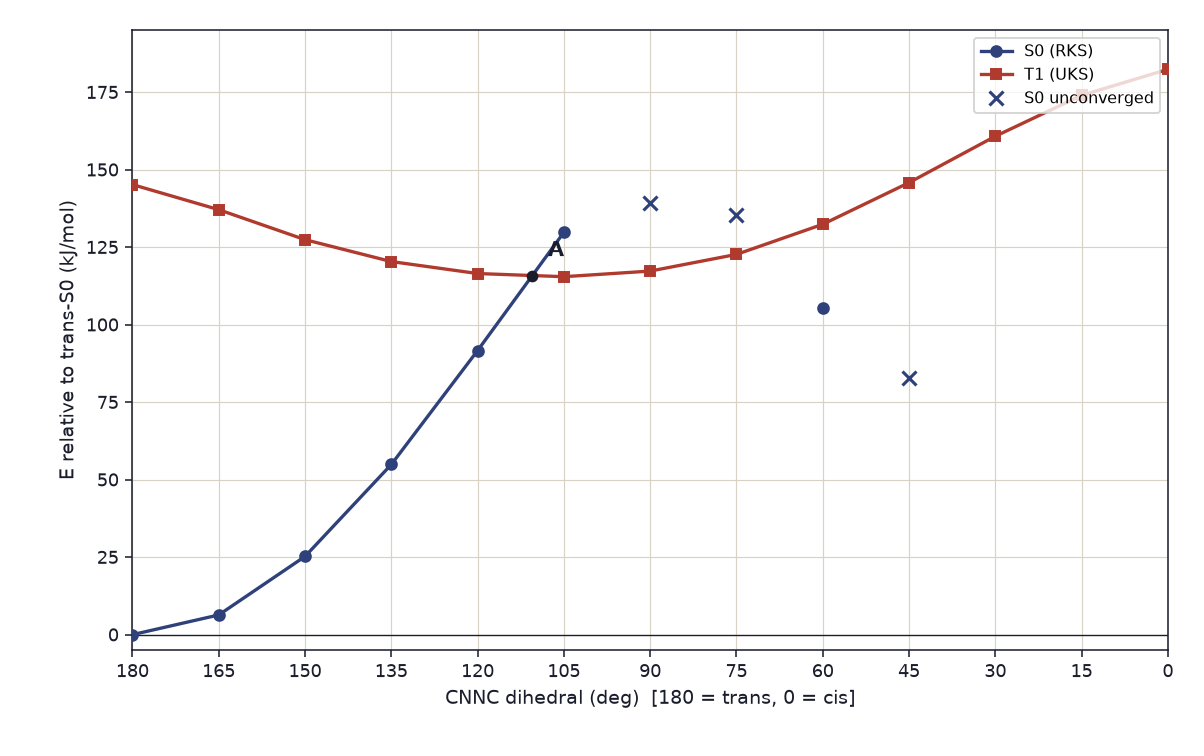
Figure 2. M4 S0 (RKS, circles) and T1 (UKS, squares) versus CNNC dihedral, energies relative to trans S0. Crosses mark unconverged S0 points. A is the linear zero between the both-converged 120° and 105° points.
At 60° the gap is -27.08 kJ/mol, both-converged. The linear zero of the 105° / 60° pair is 89.4°. That pair skips the unconverged S0 points at 90° and 75°.
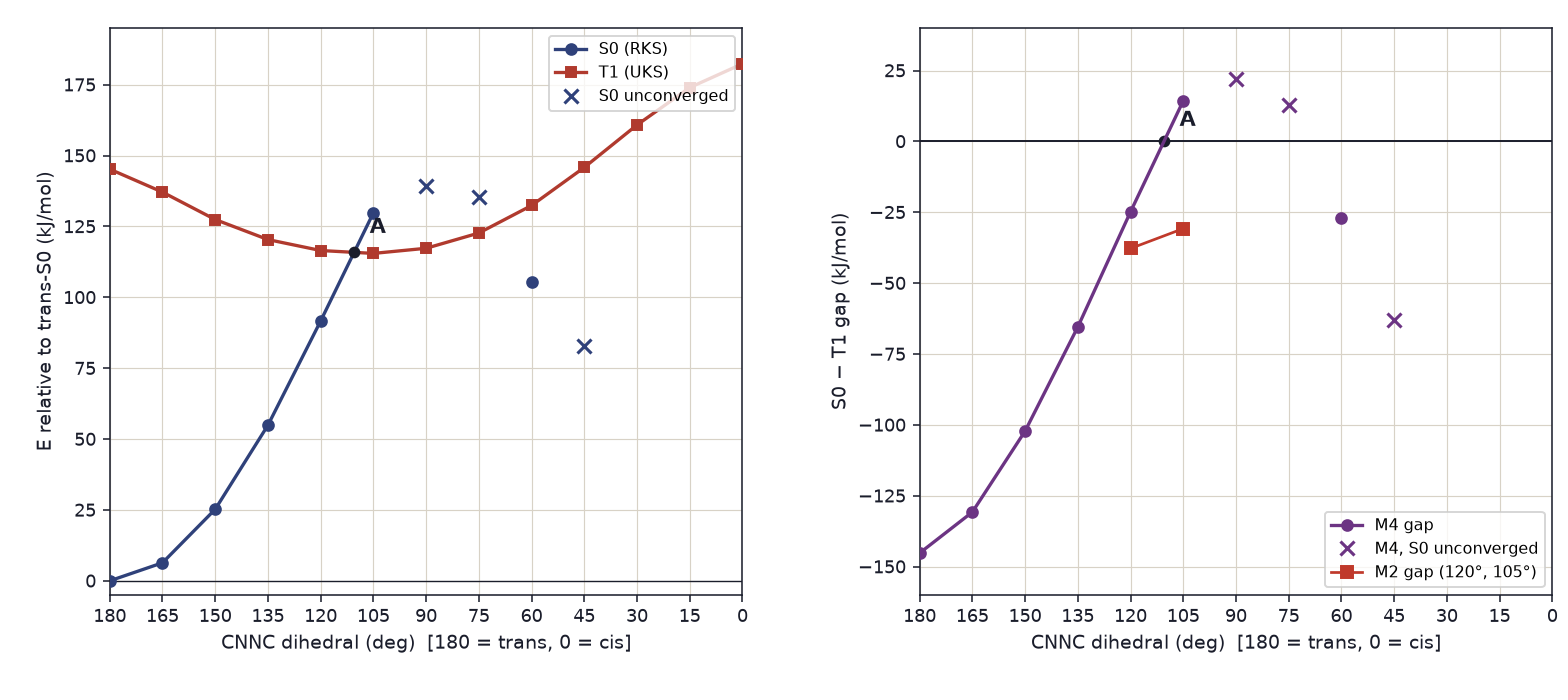
Figure 3. Left: the M4 profiles of Figure 2. Right: M4 S0 − T1 gap and the M2 gaps at 120° and 105°. A is the M4 120°/105° zero.
Discussion
The registered hypothesis was falsified. M4 has a both-converged S0/T1 sign change between 120° and 105°, at 110.5°. M2, the protonated control that the 2024 paper reports as having lost its crossing, stays negative at those same two angles. The 2024 generalization — that the loss of the crossing “would likely” extend from AzPyH+ to the wider class of push-pull azobenzenes — did not hold for this dye, at this level of theory, on this gas-phase grid.1
That is as far as the verdict goes. It is a verdict on our hypothesis and our scan. It is not a statement that Hillel et al. were wrong, and it is not a rebuttal of the 2026 HPAS paper. The 2026 calculation is CASSCF/QD-NEVPT2 on a tautomerizable hydroxyquinoline azo dye after SF-TDDFT had failed; this calculation is RKS/UKS B3LYP-D3(BJ)/cc-pVDZ on 4-dimethylamino-4′-nitroazobenzene.2 Different scaffold, different method, different question. If a knowledgeable reader has already seen this crossing on M4 at a comparable level, we would rather be told.
The controls behave as a same-footing check of the protocol. M0, M1, and M3 each keep a trans-side crossing near 115–116°, which is the direction Cembran et al. established for azobenzene and Hillel et al. reported for AzPy.1,3 M2 does not cross between the two converged neighbours that decide the claim. Several M2 S0 points, including trans, did not converge; those unconverged S0 energies remain upper bounds. Most of those M2 gaps are already negative and can only become more so if S0 drops; the 60° gap is the exception — positive and unconverged — and reconverging it can only move that cis-side oscillation toward or through zero. It cannot invent a trans-side crossing we missed on the both-converged 120°/105° pair.
Two features of the M4 cis side should not be over-read. First, the 105°→60° sign change interpolates to 89.4°, but 90° and 75° are unconverged S0 upper bounds, so that zero is not a tight second crossing and is not claimed as an MECP. Second, M0 has extra both-converged zeros at 27.8° and 8.8° on the cis-side continuation. Those look like path hysteresis of a constrained optimizer walking downhill from trans, not a second mechanism.
The limits that would overturn or shrink this reading are the obvious ones, and they are mostly on our side. The method is single-reference DFT on a coordinate where S0 and T1 approach each other and where Hillel et al. already warn that a single determinant is a poor description.1,2 We have no \(\langle S^2\rangle\) from the default UKS output. The run is gas-phase; dichloromethane, the solvent of the 2024 experiments, is absent. The 90° and 75° S0 points did not converge even at 300 iterations. We did not locate a minimum-energy crossing point, and we did not run SF-TDDFT or CASSCF/QD-NEVPT2 on M4. A solvent model, a spin-pure method, or a located MECP could move or remove the 120°/105° zero. That would be a different experiment, and we would treat a discrepancy as something to chase through our own setup first.
Conclusion
Under RKS/UKS B3LYP-D3(BJ)/cc-pVDZ, the classic NMe2/NO2 azobenzene still crosses S0 and T1 on the way from trans toward cis. Protonated AzPy, on the same grid, does not. The 2024 push-pull sentence did not hold for this dye under these conditions.
The next experiment on the shelf is not a repair of this scan. Optional reconvergence of M2 S0 at 90°, 75°, and 60° is not needed for the claim: the claim is decided by the both-converged 120°/105° pair, not by those unconverged points. The useful follow-up is one of the two parked calculations — a two-dihedral scan of 4-hydroxyazobenzene, or an ORCA SF-TDDFT treatment of M4 — so that the same molecule can be read with the method the 2024 paper actually used. Neither has been started. If the right next calculation is a different one, that is information we do not have, and we would like to be told.