
The full archive
Chemistry, physics, mathematics, art, software, and systems — newest first.
2026
Borazine's EOM-CCSD gap is negative at def2-TZVP; 2b needs more memory
Borazine's EOM-CCSD gap shifts from +117.6 to −47.5 meV; Amendment 1 is non-decisive. The 2b ADC(2) handoff is ready for a team with more compute.
Borazine keeps its inverted ADC(2) gap
PySCF reproduces borazine's inverted ADC(2) gap; a smaller-basis EOM-CCSD check gives the opposite sign.
Does a denser 90–105° same-geometry SF-TDA bracket keep the Hillel M4 sign change?
A 5° fill of this site's 2026-08-28 same-geometry two-root rematch of Hillel, Rough, Barrett, Pietro, and Mermut (2024) SF-TDA on 4-dimethylamino-4′-nitroazobenzene. The parent note's both-family sign change sat on a 15° 90–105° pair. This note narrows that pair with new constrained optimizations and same-geometry two-root single points at 95° and 100°.
How a brushed glaze becomes glass
A brushed glaze is an aqueous mineral suspension that a kiln turns into a silicate melt and then into a frozen glass. Color and studio texture are properties of the optical species and of how far that melt equilibrates before it freezes.
Does the 2026-08-27 Hillel M4 SF profile-gap survive a same-geometry two-root rematch under Hillel 2024 SF-TDDFT?
An independent same-geometry two-root rematch of this site's 2026-08-27 Hillel M4 SF-TDA geometries at the Hillel, Rough, Barrett, Pietro, and Mermut (2024) electronic-structure level. The parent note's sign change was a separately relaxed profile gap. This note asks whether ΔE = E(T1)−E(S0) still changes sign when both roots come from one SF manifold on one structure.
Does Hillel M4 still show an S0/T1 crossing near 110° under Hillel 2024 SF-TDDFT?
An independent rematch of Hillel, Rough, Barrett, Pietro, and Mermut (2024) SF-TDDFT on 4-dimethylamino-4′-nitroazobenzene. The published 2026-08-22 RKS/UKS note found a both-converged S0/T1 sign change on this dye. This note asks whether that crossing remains when S0 and T1 are taken from the SF-TDDFT manifold at the 2024 electronic-structure level.
Does Johnson's invited CX3 rotation oscillate carboxylate oxygen charge more for CCl3 than for CF3?
An independent B3LYP-D3(BJ)/aug-cc-pVDZ rematch and relaxed CX3 rotation of CF3COO− and CCl3COO−, taking the geometry/bond-rotation invitation in Johnson et al. 2025. Binding charges are MBIS.
Does Hillel's 2024 push-pull sentence hold for 4-dimethylamino-4′-nitroazobenzene?
An independent RKS/UKS B3LYP-D3(BJ)/cc-pVDZ CNNC torsion scan of an untested 2024 generalization — that push-pull azobenzenes, like protonated AzPyH+, would lose the S0/T1 crossing along the azo twist. The test case is 4-dimethylamino-4′-nitroazobenzene, with azobenzene, AzPy, AzPyH+, and 2-phenylazopyridine as controls.
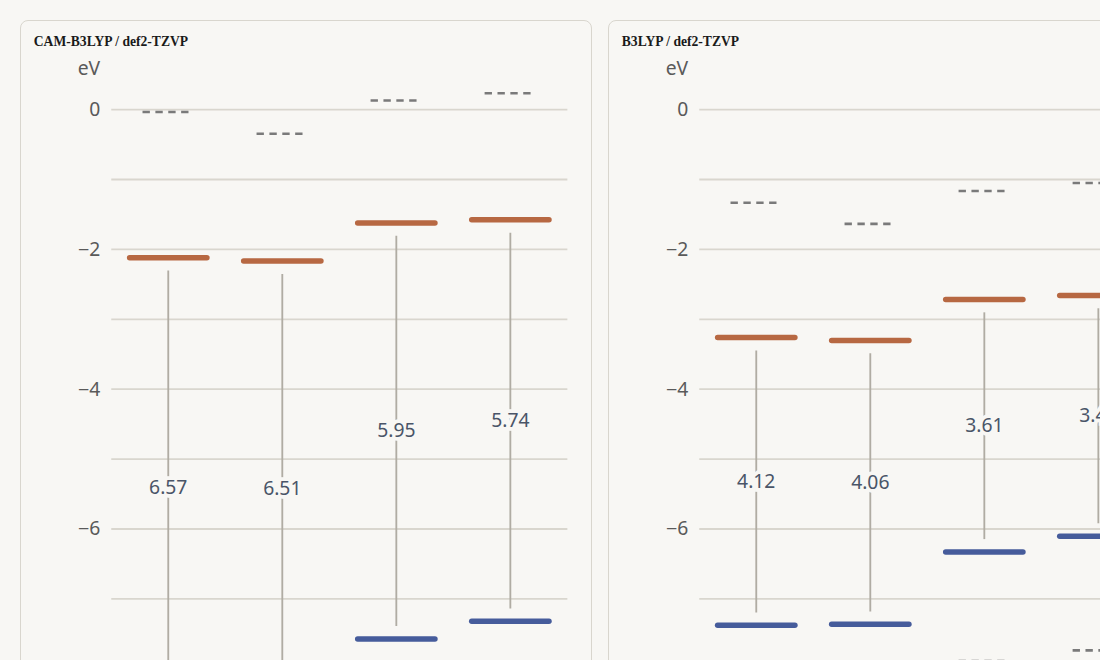
How the donor closes the gap: para-substituent effects in a minimal push-pull dye
A four-point series of para-X-benzylidenemalononitriles (X = H, F, NH₂, NMe₂) shows how donor strength moves the HOMO and LUMO, and explains why para-fluorine acts as a weak net donor in this minimal push-pull scaffold.
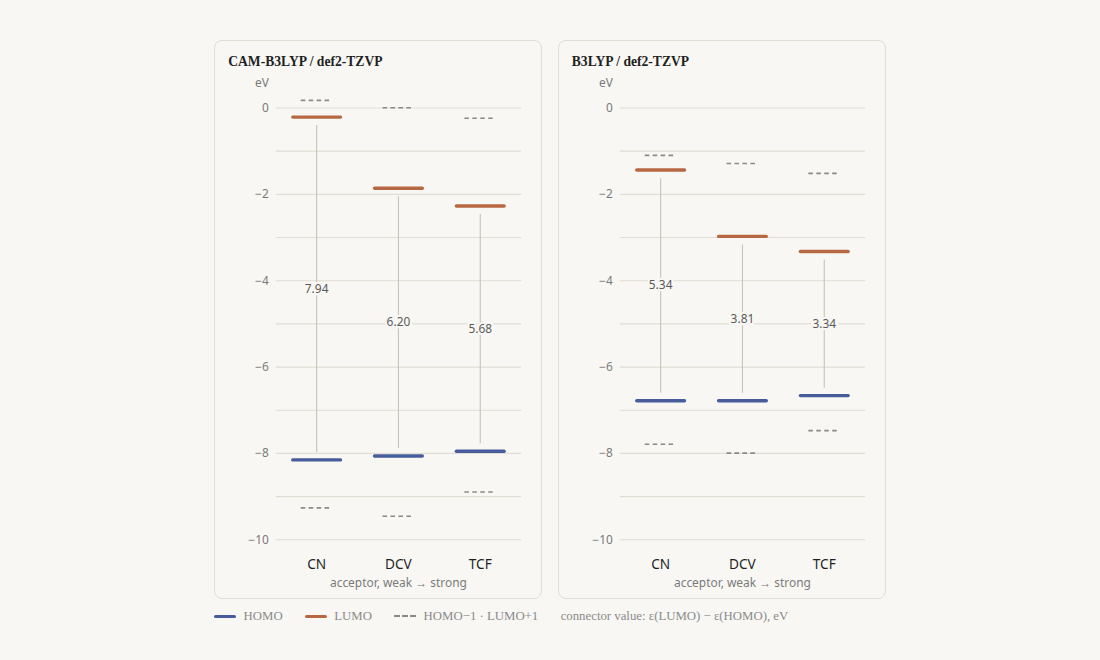
How the acceptor closes the gap: acceptor-strength effects in para-methoxy push-pull dyes
A three-point series of para-methoxy push-pull dyes with CN, DCV, and TCF acceptors shows how acceptor strength moves the HOMO and LUMO, and how the HOMO-LUMO gap closes as the acceptor strengthens.
One dye, one transition: how DCDHF-Me2 earns the two-level picture
The blinking-to-absorption note modeled a fluorescent dye as two levels and named what that hides. Computing the actual excited-state manifold of DCDHF-Me2 — a push-pull dye engineered for single-molecule imaging — gives a sharper answer than we planned. Its visible absorption is essentially one transition, and the rest of the manifold lives in the deep UV; benzene, the dye's own parent ring, shows the opposite arrangement for a reason symmetry makes plain.
From blinking to absorption: how one molecule becomes a spectrum
A single fluorescent molecule blinks; a cuvette full of the same molecules gives a smooth absorption band. The two pictures are the same Jablonski diagram read at different scales — one molecule versus an ensemble, one photon at a time versus a steady-state rate. This post traces the path from quantized absorption and emission events to a bulk spectrum, and extends the same diagram to two-photon absorption as the nonlinear version of the same transition.
Extending Villatoro et al.'s SIREN benchmark: the momentum recovery region
An independent extension of Villatoro, Geraci, and Schiavazzi's 2026 multi-fidelity SIREN benchmark maps, as a function of the heavy-ball momentum coefficient, the set of learning rates at which the described SIREN convention reaches the official convention's error floor.
One muon, two frames, and the workflow that parked itself
A minimal muon time-dilation calculation was pushed through a preregistered, multi-role research workflow as an acceptance trial. The two frames agreed exactly as they must; the workflow coordinated every step, then parked itself over a figure label. This note explains both machines.
Why some atoms cost more than their neighbors
A fixed atomic calculation separates the cost of how an atom is represented from the cost of getting its self-consistent field to settle.
Does force weight keep moving the H2+ crossover in Rana et al.'s 1/R scheme?
An independent H2+ implementation extends Rana et al.'s 2025 1/R Conundrum by sweeping force-loss weight over four decades; endpoint classifications change when the training budget is doubled.
Can conical-intersection hops outrun coherence? An independent extension of Galiana et al.
An independent sensitivity extension of Galiana et al.'s pulse-independent trajectories separates mean single-trajectory coherence magnitude from phase-sensitive ensemble coherence and stops at a failed convergence gate.
Four terminals and an inbox: growing agent skills from their own message history
I ran an app-development workflow as four separate Claude Code sessions — each owning one role, all talking through a shared inbox — and then pointed a fresh session at the accumulated messages and asked it to write the skills. This is how the bootstrap worked, why the distillation step is the interesting part, and what it cost.
Does Blackmon and Closser's near-uniform sulfamethoxazole ensemble survive a thermal correction?
Blackmon and Closser report four solvated sulfamethoxazole minima with 298 K populations of roughly one quarter each, assigned from electronic energies alone. This note is an independent extension that adds a preregistered GFN2-xTB thermochemical correction to their published energies. The near-uniform ensemble does not survive the correction under either registered arm, while the published global minimum keeps its place.
Does one C=C increment fit every alkene? Two preregistered tests of Witkowski and co-workers' correlation energy per bond
Witkowski, Śmiga, Hirata, Dral and Grabowski estimate molecular correlation energies as a sum of fitted bond-type increments and state that the assignment holds regardless of conjugation or geometry. This note is an independent reanalysis of their published tables plus a new coupled-cluster calculation on the four butene isomers their model cannot distinguish. Both preregistered verdicts came out inconclusive under the frozen decision rules; what survives is a systematic offset in the price of one bond swap and a measurable correlation split among isomers the model assigns identical energies.
Counting the inbox: what an agent message corpus records about roles nobody designed
An earlier note described distilling four agent skills out of a shared on-disk inbox, and admitted that the transcripts were neither counted nor quoted. This one counts them and quotes them — how long each code name lasted, how the traffic decayed once the skills existed, and what the sessions wrote to each other about promotion, protocol, and disagreement.
How electron correlation survives a hydrogenation enthalpy subtraction
A worked CCSD(T)−HF calculation shows how large molecular correlation energies mostly cancel in reaction enthalpies, what survives that subtraction, and why the residual should not be assigned to one π bond.
Does force training move where Coulomb subtraction helps an H2+ neural potential?
A matched neural-network experiment on the one-electron H2+ curve asks whether adding force labels moves the bond-distance cutoff at which subtracting the exact nuclear repulsion stops helping the fit. Force labels sharpen the advantage against the repulsive wall but move the crossover inward, the opposite of the predicted direction.
Why a microwave oven is not tuned to water
A microwave oven heats liquid water through dielectric relaxation, not a narrow resonance. A traceable single-Debye calculation separates the dielectric-loss-factor peak from attenuation, quantifies a pure-water baseline, and shows why the same idealized channel is weak in ice.
From script to sentence: a traceable Brewster-angle calculation
A tiny Fresnel calculation shows how this site now carries computed values from versioned inputs into prose without mistaking traceability for correctness.
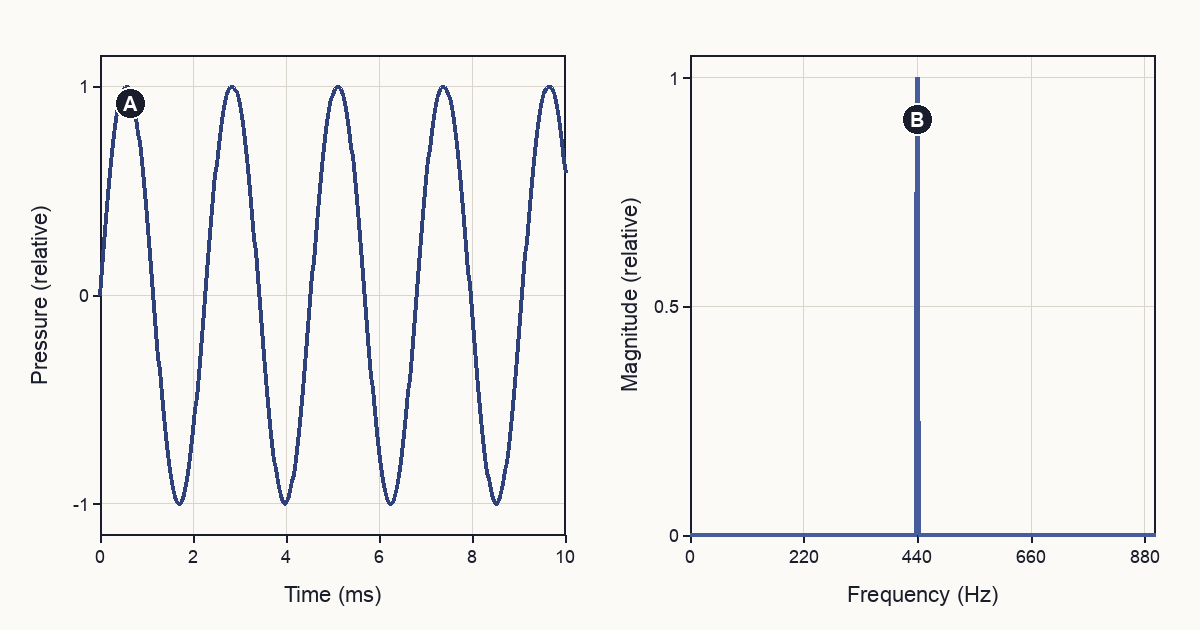
What a chord looks like: sound waves, harmonics, and Fourier transforms
A C-major chord is both a complicated pressure wave and an orderly spectrum. Synthetic signals connect those views through harmonics, tuning, beats, and nonlinear mixing—then mark where acoustics stops explaining music.
Extending Villatoro et al.'s SIREN benchmark: the momentum control
An independent extension of Villatoro, Geraci, and Schiavazzi's 2026 multi-fidelity SIREN benchmark tests heavy-ball momentum, preserving the omega_0 squared hidden-step factor while moving the stability boundary up by about 1+beta and closing the K1 accuracy gap at one tested rate.
Repeatable, but not blind: a frozen LLM pilot on off-tonic recapitulation
Three frozen command-line model systems repeatedly scored identity-withheld sonata-form dossiers whose focal cases come from Greenberg's 2025 off-tonic recapitulation study — an independent reliability pilot, not a test of his analysis. The pilot measured stability, cross-system agreement, output validity, and elicited repertoire identification before deciding whether the design should expand.
Where Coulomb subtraction helps a neural potential fit
A matched neural-network experiment maps where subtracting exact nuclear repulsion makes an H2+ potential easier to fit. The advantage is large on a domain containing the repulsive wall and disappears as the domain moves beyond equilibrium.
When pulse-independent trajectories lose nuclear accuracy: testing Galiana et al.'s open regime
An independent benchmark of the conical-intersection regime left open by Galiana et al. finds that reusing nuclear paths can preserve electronic populations while doubling nuclear-centroid RMSE.
The SGD control: 900 on the hidden stack, no resolved learning-rate gap on K1
Yesterday's Adam note predicted that the two SIREN conventions' hidden function-space steps differ under plain SGD by omega_0 squared. On the isolated stack they do — 899.86 — while a direct displacement decomposition and a 0.05-decade sweep resolve no global learning-rate gap on K1.
Why the two SIREN conventions train differently under Adam
The two circulating SIREN conventions are the same function at initialization to machine precision, but not the same optimization problem. Under Adam, their hidden-layer steps differ in function space.
The SIREN that was a straight line
A recent paper specifies a SIREN by taking its initialization from one convention and its activation from another. Instantiated literally, every hidden sine sits in its linear regime and the network collapses to a single Fourier layer.
How slowly must you pump an anomalous soliton?
A new anomalous soliton pump is quantized only in the adiabatic limit, and the paper says only that its parameter must be varied "sufficiently slowly". Measured, the anomalous pump needs a 4.3x slower ramp than the normal one — and above that threshold it still misses the quantized value at 9 of 18 periods, once by more than a full unit cell.
The missing speedup ledger in h/p-adaptive SPH
Joining two accuracy statements to the paper's timing table puts a number on the benefit of h/p-adaptive SPH: 3.90x and 6.16x speedups for its two explicit equal-accuracy vortex-ring comparisons.
Temperature zero is not determinism: your logits depend on who else is in the batch
Enumerating every ordering of a signed sum shows that reordering moves the result by one ulp — far too little to explain why temperature-zero endpoints return different paragraphs. The rest of the story is batch invariance, bfloat16, and argmax.
No lens burns hotter than the sun: étendue and the second law
Give me a perfect lens of any size and I still cannot heat a target past about 5800 K with sunlight. The limit is not engineering, and it is not diffraction — it is Liouville's theorem wearing an optics costume, and it hands back the solar constant as a receipt.
Two runs, two answers: floating-point sums aren't associative
Run the same simulation on four cores and eight and the total energy disagrees in the twelfth digit. That is not a bug in your code — it is floating-point addition refusing to be associative, and the fix is not to make the hardware lie but to know your noise floor.
Refraction is absorption you can't see
A material that absorbed no light at any frequency would have a refractive index of exactly 1 — no lenses, no prisms, no rainbows. Refraction is not the opposite of absorption; it is a causal side effect of it, and the Kramers–Kronig relations say exactly how much.
A spreadsheet that runs payroll: a pipeline in Google Apps Script
Every two weeks I used to open a time-clock export and copy each employee's shifts, by hand, into a payroll workbook — an afternoon of careful, error-prone transcription. Now it's a one-minute import from a menu inside the spreadsheet itself. This post is the big-picture tour of how that works: what Google Apps Script is, bound versus standalone projects, converting an uploaded .xlsx on the fly, writing live formulas so a hand edit still cascades, and getting the code out of the browser and into local files and git with clasp.
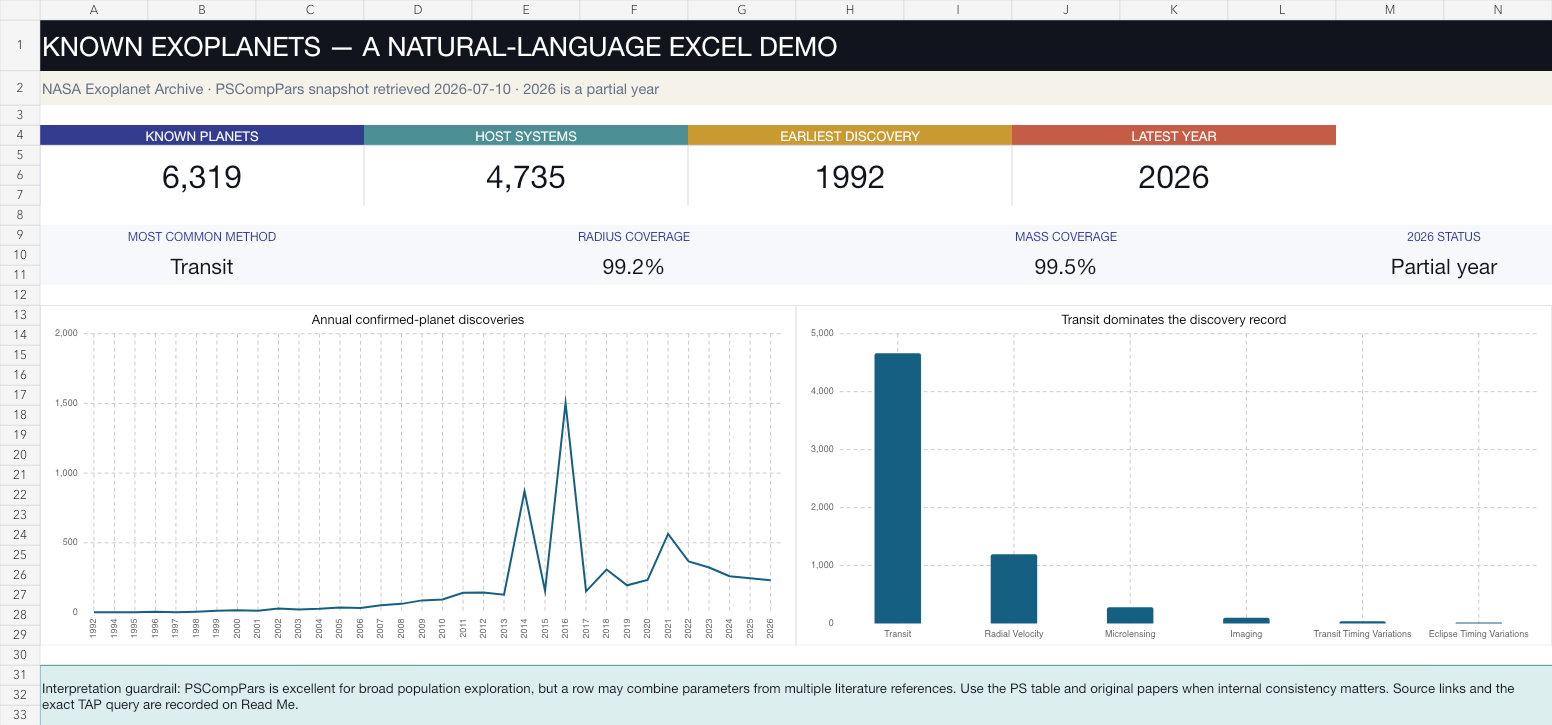
From a Prompt to a Polished Excel Workbook with Codex and Sol
A reproducible demonstration of turning NASA exoplanet data into an auditable Excel workbook with natural-language prompts, Codex, the Sol model, and generated Python.
Forbidden and allowed: what symmetry does to a spectrum
Dissolve cobalt chloride in water and the solution is pale pink; add hydrochloric acid and it turns an intense blue — same ion, same kind of transition, a hundredfold jump in intensity. The gap didn't change; the symmetry did. This post pays the pigment series' oldest promissory note and explains what "forbidden" and "allowed" actually mean — one integral, one parity argument, one character table — and why forbidden bands show up anyway.
Molecules as circuits — a chromophore as an RLC resonator
An absorption energy gap is a resonant frequency, a transition dipole is charge sloshing across a capacitor, and a linewidth is a resistance — so a dye molecule is literally a driven RLC circuit. This post makes the analogy pay its way, pinning every circuit element to a number from a real chromophore I synthesized, then shows the three places the model quietly stops describing the physics: the hyperpolarizability, the quantum interference in the wiring, and the many-body order that actually sets device performance.
One donor, one acceptor, one new band: push–pull chromophores and charge transfer
Aniline and nitrobenzene each absorb only in the ultraviolet. Bolt the amino donor and the nitro acceptor onto the same ring and a new band appears that neither parent owns — lower in energy and brighter than anything either shows alone. This post computes that emergence with TD-DFT, measures the charge-transfer character directly, and uses it to stress-test two density functionals against a failure mode one of them is famous for.
The colors on the palette are energy-level gaps: engineering pigments for permanence
A tube of paint is an electronic-structure problem plus a scattering problem, perceived by an eye. This post builds the mechanism-first taxonomy of color — conjugated π-systems, ligand-field d–d transitions, charge transfer, and semiconductor band gaps — leading with the modern synthetic pigments engineered to fix the lightfastness failures of their historic ancestors, then puts absorption and scattering back together with Kubelka–Munk.
How much does correlation really cost? The correlation gap in water, measured
The Hartree–Fock post drew its correlation-gap figure schematically. This post runs the actual calculations — RHF marched up a basis-set ladder to its limit, MP2 and CCSD(T) below it — and reports what electron correlation costs, in hartrees, for one bent molecule of water.
One matrix element, two experiments: molar absorptivity and the Pockels effect
A companion to the molar-absorptivity post. The absolute height of an absorption band, the refractive index, and the electro-optic coefficient of a poled material are three readouts of one quantity — the transition dipole. Normalizing every spectrum to 1 throws that quantity away. This traces the same matrix element from Beer's law through the two-level model to the Pockels effect, with worked numbers.
Molar absorptivity is a rate constant in disguise
The molar absorptivity in Beer's law looks like a static property of a molecule — a number you read off a table, like a melting point. It is not. The integrated absorption band is proportional to the same transition dipole that fixes the spontaneous-emission rate, so an absorption measurement quietly measures a lifetime. This post follows the chain from Beer's law to the Einstein coefficients and shows why weak absorbers are always slow emitters.
Hartree–Fock and the correlation gap: where the orbital energies come from
A water molecular-orbital diagram quotes orbital energies as if they were just there to be read off. This post derives the ground-state machinery — the Hartree–Fock equations, their self-consistent solution, Koopmans' theorem, and the correlation energy that the mean field leaves behind — that actually computes them.
Reading water off the page: geometry, orbitals, acidity, and spectra
Water is the most familiar molecule and one of the strangest. This post builds it up from the bottom — where the atoms sit, what the electrons do, why it is both an acid and a base, and how it talks to light.
The anatomy of a Hakyll site, line by line
A complete reference for the Haskell that builds this blog — the package layout, the Hakyll rule set, contexts, feeds, the Pandoc compiler with citations and math, the build-time TikZ filter, and the templates — presented as numbered code blocks with a detailed explanation of each.
What are cloud functions? A practical tour with real code
A from-scratch explanation of what cloud functions actually are, the problem they solve, and three real-world examples — an image-resize trigger, a scheduled report, and a webhook handler — written in JavaScript, Python, and Go with line-by-line explanations of what each function does.
gcloud, Firebase, and why I keep paying for a Workspace account
A working tour of Google Cloud and Firebase — what each one actually is, where the line between them sits, how they integrate through a shared project and IAM, and why a paid Google Workspace account ends up being the quiet keystone that ties it all together.
The Met API has no random button
A year ago I shipped a one-button "random artwork" toy on top of the Met Museum API. It has since grown into a four-screen app — and the interesting part is what you do when the API you're randomizing over has no way to hand you something random. Manufacture it. And once you can manufacture randomness, a deterministic "artwork of the day" falls out for free.
A citation, a slot, and the line nobody plots
Running my day job on Claude Code — an agent architecture for non-software work
My day job isn't writing software — it's coordinating insurance-restoration jobs, which is document-heavy and relentlessly repetitive. Over a few months I built a system of Claude Code agents around that workflow. This is the architecture, the decisions that made it hold together, and what I'd change.
Reading the source — the circuitikz behind four schematics
A follow-up that opens up the four circuits from the previous post and shows the circuitikz source for each — the RC low-pass filter, the series RLC, the inverting op-amp, and the full-wave bridge rectifier — line by line.
Hardening the open CORS proxy — allowlists, SSRF guards, and the bypass I almost left behind
A year after building an open serverless CORS proxy, I closed the open-relay hole it had become — target and origin allowlists, SSRF guards, a resilience layer — and learned a sharp lesson about a forgotten debug endpoint that Vercel was still routing.
A light wave from Maxwell's equations, rendered in pure TikZ
Deriving the electromagnetic plane wave from Maxwell's equations, then drawing it with build-time TikZ — and the Haskell pipeline rebuild (lualatex + dvisvgm) that finally renders its transparency.
Schematics that compile — circuit diagrams in pure TikZ
Teaching the build-time TikZ pipeline to draw electrical schematics with circuitikz, demonstrated with four classic circuits — an RC filter, a series RLC, an inverting op-amp, and a full-wave bridge rectifier.
Quantum Tunneling Workflow for Hydrogen Peroxide - PES Scans, kappa Corrections, and Instanton Integration
An ACS-style, AI-authored workflow note that couples a relaxed PES scan with semiclassical tunneling corrections and an i-PI ring-polymer instanton sketch, including charts, tables, and runnable code.
Two barriers, one tunnel: the hydrogen peroxide torsion, recomputed
The original version of this post validated its H2O2 torsional barrier against the wrong experimental number and reported tunneling corrections from code that assumed its own conclusions. Recomputed from scratch — a fresh MP2/cc-pVTZ relaxed scan, the periodic torsional Schrödinger equation solved on the resulting potential, and transmission through the barrier that actually matters — with the tunneling splitting checked against sixty years of far-infrared spectroscopy.
2025
Visual Process Documentation - Measuring Efficiency Through Domain Crossing Analysis
A simple methodology for documenting and measuring process efficiency by visualizing the movement between digital and physical work, with practical applications for office workflow optimization.
Building a Random Art Generator with the Met Museum API and a Serverless CORS Proxy
Taking a break from science to explore art and technology with a web application that makes the Metropolitan Museum's collection accessible through a custom-built CORS proxy solution.
Building a Serverless CORS Proxy with Vercel - Simplifying Cross-Origin Requests
A practical exploration of building a serverless CORS proxy using Vercel's serverless functions, offering an elegant solution to the common cross-origin resource sharing challenges faced by frontend developers.
Three exact solutions and one inequality: quantum chemistry's ground floor, computed
The particle in a box, the harmonic oscillator, and the hydrogen atom are the only systems in quantum chemistry you can solve with pen and paper — which makes them the only place you can hold your numerics fully accountable. Every figure here is computed, every number is checked against its closed form, and a psi4 basis ladder shows the one atom where Hartree–Fock is the whole answer.
Understanding the Virial Equation - A Systematic Taylor Expansion of the Ideal Gas Law
An exploration of how the virial equation emerges as a Taylor expansion of the ideal gas law, providing a systematic way to account for molecular interactions in real gases.
Visualization of Compression Factor Behavior in Real Gases - A Virial Equation Approach
A computational exploration of how compression factors vary with temperature and pressure for common gases, demonstrating the transition between attractive and repulsive molecular interaction regimes.
Determination of SI Units for Magnetic Interactions in Quantum Mechanical Calculations
A systematic derivation of the SI units involved in magnetic interactions at the quantum level, focusing on the correct dimensional analysis of magnetic moments, fields, and coupling constants.
Setting Up a Comprehensive Quantum Chemistry Environment on Linux
A detailed guide for establishing a versatile computational chemistry environment on Linux systems with instructions for package installation, environment configuration, and remote access setup.
AI Assisted Computational Tools for TDDFT Analysis of Chromophores Supplemental Information
A suite of Python-based computational tools for efficient geometry optimization, TD-DFT calculations, and spectral visualization of chromophores, providing a systematic approach to predicting electronic transitions and optical properties.
AI Assisted Computational Tools for Time-Dependent Density Functional Theory Analysis of Chromophores
A suite of Python-based computational tools for efficient geometry optimization, TD-DFT calculations, and spectral visualization of chromophores, providing a systematic approach to predicting electronic transitions and optical properties.
Mathematical Frameworks and Basis Sets in Excited State Calculations
A comprehensive explanation of the mathematical principles underlying excited state calculations, including TD-DFT, EOM-CCSD, ADC, and CASSCF methodologies, as well as detailed discussions on basis set selection, computational considerations, and practical applications.
Comparative Analysis of TD-DFT Functionals for Formaldehyde Excited States
A systematic comparison of different DFT functionals for predicting formaldehyde excited states, revealing significant variations in excitation energies and oscillator strengths across methods.
Modern DNS Analysis on macOS - Beyond nslookup
A comparative analysis of traditional and modern DNS query tools on macOS, with practical examples and insights for network administrators and security professionals.
PowerShell Command Line Fundamentals - A Structured Learning Approach
A methodical introduction to PowerShell fundamentals with structured experimental procedures and evaluation of command functionality.
Polarizability Trends in Carbon-Chalcogen Diatomic Molecules - A Computational Study
A systematic computational investigation of polarizability in diatomic molecules formed between carbon and Group 16 (O, S, Se, Te) elements, with analysis of geometry-optimized structures and higher-order electronic properties.
Polarizability Trends in Group 14-16 Heteronuclear Molecules - A Computational Study
A systematic computational investigation of polarizability trends in diatomic molecules formed between Group 14 (C, Si, Ge, Sn, Pb) and Group 16 (O, S, Se, Te) elements, showcasing the power of automation and open-source computational chemistry tools.
Mathematical Framework for Hyperpolarizability Calculations
A detailed explanation of the mathematical principles underlying hyperpolarizability calculations
Quantum Chemical Calculations of Hyperpolarizability - Setup and Initial Results
A detailed walkthrough of setting up computational environment for calculating hyperpolarizabilities of Group 4A elements
Calculating Atomic Polarizabilities of Group 14 Elements Using Psi4 - A Finite Field Approach
An experimental study calculating polarizabilities of Group 14 elements using Psi4's finite field method, with results for C, Si, and Ge, and insights into limitations for heavier elements.
Network Path Analysis - Evolving Network Diagnostics for the Modern Security Landscape
Network Path Analysis - Evaluating Diagnostic Tools in Security-Hardened Modern Networks
A modern networking laboratory exercise for Mac users exploring ICMP protocols and network diagnostics