
Does Johnson's invited CX3 rotation oscillate carboxylate oxygen charge more for CCl3 than for CF3?
Abstract
Johnson, Gregory, Robertson, Gresham, Nelson, Craig, Prescott, Page, Webber, and Wanless (2025), in The inductive effect does not explain electron density in haloacetates: are our textbooks wrong?, reported DDEC6/MP2/aug-cc-pVQZ charges in which CCl3 withdraws more from the carboxylate oxygens than CF3, proposed carboxylate π → σ*(C–X) hyperconjugation, cited ESI Table S2 bond-length signs, and invited geometry/bond rotation studies.1 This note is an independent relaxed CX3 scan, at B3LYP-D3(BJ)/aug-cc-pVDZ with MBIS charges, of that invitation: we ask whether carboxylate oxygen charge oscillates with CX3 rotation, with larger amplitude for CCl3COO− than for CF3COO−.
The registered hypothesis was that Hirshfeld and MBIS oxygen charges (and the COO sum) oscillate with the X–Cα–C–O dihedral, with peak-to-peak amplitude larger for CCl3COO− than for CF3COO−. On the both-converged 0–120° grids the MBIS \(q(\mathrm{O})\) amplitudes, in e, are 0.000524 (CF3) and 0.000074 (CCl3). The \(q(\mathrm{COO})\) amplitudes, in e, are 0.000405 and 0.000599. After the scan we scored falsifier 2 on \(q(\mathrm{O})\); false. The registered inconclusive outcome is false. The hypothesis-supported flag is false. The verdict is inconclusive if the first of those flags is true, supported if the second is true, and otherwise falsified. That is a verdict on our hypothesis and this scan, not a grade on Johnson et al.
Introduction
Haloacetate ions, \(\mathrm{CX_3COO^-}\), are a standard classroom example of the inductive effect: a more electronegative \(\mathrm{CX_3}\) group is expected to withdraw electron density from the carboxylate and to lower \(\mathrm{p}K_\mathrm{a}\). Johnson, Gregory, Robertson, Gresham, Nelson, Craig, Prescott, Page, Webber, and Wanless computed gas-phase trihaloacetates at MP2/aug-cc-pVQZ and partitioned the density with DDEC6.1 They reported the opposite order for the carboxylate oxygen charges: CCl3 withdraws more than CF3. They attributed that pattern to carboxylate \(\pi \rightarrow \sigma^*(\mathrm{C{-}X})\) hyperconjugation, noted that ESI Table S2 shows a larger in-plane versus out-of-plane C–X length difference for CCl3 than for CF3, and wrote that further computational work including geometry/bond rotation studies could help elucidate the role of that hyperconjugation.
That sentence is an invitation, not a published rotation. We could not find a relaxed \(\mathrm{CX_3}\) scan of CF3COO− and CCl3COO− that asks whether the carboxylate oxygen charge moves with the torsion, or whether that motion is larger for CCl3. The 2025 minima and the ESI bond-length signs are the nearest published neighbours, and they are not a scan. That is the untested regime.
The hypothesis, frozen 2026-08-23 before any rematch energy or torsion: On a relaxed CX3 rotation, Hirshfeld and MBIS oxygen charges (and the COO sum) oscillate with the X–Cα–C–O dihedral. Peak-to-peak amplitude is larger for CCl3COO− than for CF3COO−. Acetate is the flat control. Amplitude is \(\max-\min\) on both-converged points, reported separately for \(q(\mathrm{O})\) and \(q(\mathrm{COO})\). The falsifier, fixed at the same time: (1) \(q(\mathrm{O})\) is flat vs dihedral on both haloacetates, or (2) CF3 amplitude \(\ge\) CCl3 amplitude. Either outcome is publishable. A larger CCl3 swing would be the first same-footing rotation bound we have for the 2025 invitation; a miss would mean this independent scan did not exhibit the predicted CCl3 \(>\) CF3 oxygen-charge amplitude.
Computational Methods
This is an independent implementation. The source authors’ MP2 geometries, orbitals, DDEC6 charges, and energy tables were not imported, and none of their program was used.1 Psi4 1.11 was the executable.2 Each ion is charge \(-1\), singlet, gas-phase. No polarizable continuum was applied. The functional, dispersion, and basis are B3LYP-D3(BJ)/aug-cc-pVDZ.3–8 Binding charges are MBIS.9 Löwdin charges are reported only and are not binding.10 Hirshfeld partitioning is not compiled into this Psi4 build.11
Four ions were rematched first, before any torsion: CH3COO−, CF3COO−, CClF2COO−, and CCl3COO−. The rematch geometry inequalities were: \(r(\mathrm{C{-}C})\) satisfies CCl3 \(>\) CF3 \(>\) acetate, and \(\Delta(\mathrm{C{-}X})\) (out-of-plane minus in-plane) satisfies CCl3 \(>\) CF3. CClF2 is mixed-halogen and is not used for the \(\Delta(\mathrm{C{-}X})\) comparison. Before the first rematch energy, Hirshfeld was already unavailable in this Psi4 build, so gate (3) required both MBIS and Löwdin \(q(\mathrm{O})\) and \(q(\mathrm{COO})\) to be more negative for CF3 than for CCl3; if both failed, the scan would not run.
After rematch charges were known, and before any torsion, Löwdin on
aug-cc-pVDZ reversed the CF3/CCl3 oxygen-charge order and is
ill-defined on this basis relative to MBIS. Löwdin was demoted; binding
became MBIS-only; the both-must-pass / if-both-fail-stop pair was
vacated. That amendment is dated 2026-08-24 in
research/johnson-haloacetate/JOURNAL.md. The Löwdin reversal is
derived from rematch/summary.csv: \(q(\mathrm{O})\) is
-0.04557 e (CF3) versus
-0.04669 e (CCl3), so
false; \(q(\mathrm{COO})\) is
-0.75388 e versus
-0.88389 e, so
false. The frozen hypothesis and
falsifier were not rewritten.
The scan is a relaxed \(\phi = \mathrm{X{-}C_\alpha{-}C{-}O}\)
continuation. Optking froze dihedral 5-4-1-2. The remaining degrees of
freedom were relaxed. The grid is 0–120° in
15° steps on CF3COO− (M1) and CCl3COO− (M3).
The published abscissa is the frozen target angle. A hopping realized
dihedral is not used as the \(x\) coordinate. Published \(q(\mathrm{O})\)
is the arithmetic mean of the two carboxylate oxygen MBIS charges, not
one selected atom. The frozen dihedral uses atom 2 as the constraint;
both oxygens still enter the mean. \(q(\mathrm{COO})\) is the
carboxylate-group sum. Amplitude is \(\max-\min\) on points with
optking True and a clean exit. Energies are converted with
627.509474 kcal mol\(^{-1}\) \(E_\mathrm{h}^{-1}\). The 120°
minus 0° difference is an overlay check on the same conversion. It is
not the amplitude.
The canonical executable was
/opt/homebrew/Caskroom/miniforge/base/envs/qchem/bin/psi4 on local
Apple Silicon; the environment record is
research/johnson-haloacetate/environment.md. Raw Psi4 logs stay in
the private Molecules lab. They are large and carry host paths, and
they are treated as scratch in the same way as the Hillel-triplet
logs. What is committed is the rematch table and the two scan CSVs in
research/johnson-haloacetate/. The reproducibility label this
directory has earned is analysis-reproducible. It is not
end-to-end reproducible from this public repository.
Results
Table 1 lists the rematch gate. Table 2 lists the scan amplitudes, signed \(120^\circ-0^\circ\) charge differences, and energy ranges. Figure 1 plots MBIS \(q(\mathrm{O})\) and \(q(\mathrm{COO})\) versus the frozen target angle. Figure 2 plots the relative electronic energy.
Table 1. Rematch B3LYP-D3(BJ)/aug-cc-pVDZ optimizations. \(\Delta(\mathrm{C{-}X})\) is out-of-plane minus in-plane. A dash is a quantity that is not in the committed rematch table: acetate has no C–X pair of that kind, and CClF2 is mixed. All 4 of 4 optimizations formally converged. The frozen \(r(\mathrm{C{-}C})\) comparison CCl3 \(>\) CF3 \(>\) acetate evaluates to true. The observed CClF2 placement between CF3 and CCl3 is true and is not part of that gate. The other predeclared inequalities evaluate to true for \(\Delta(\mathrm{C{-}X})\), true for MBIS \(q(\mathrm{O})\), and true for MBIS \(q(\mathrm{COO})\).
| Ion | \(r(\mathrm{C{-}C})\) (Å) | \(\Delta(\mathrm{C{-}X})\) (Å) | MBIS \(q(\mathrm{O})\) (e) | MBIS \(q(\mathrm{COO})\) (e) | Converged |
|---|---|---|---|---|---|
| CH3COO− | 1.55891 | — | — | — | yes |
| CF3COO− | 1.58326 | 0.00737 | -0.70408 | -0.78982 | yes |
| CClF2COO− | 1.60025 | — | — | — | yes |
| CCl3COO− | 1.63548 | 0.00844 | -0.67973 | -0.57760 | yes |
18 of 18 scan points converged (optking True and a clean exit).
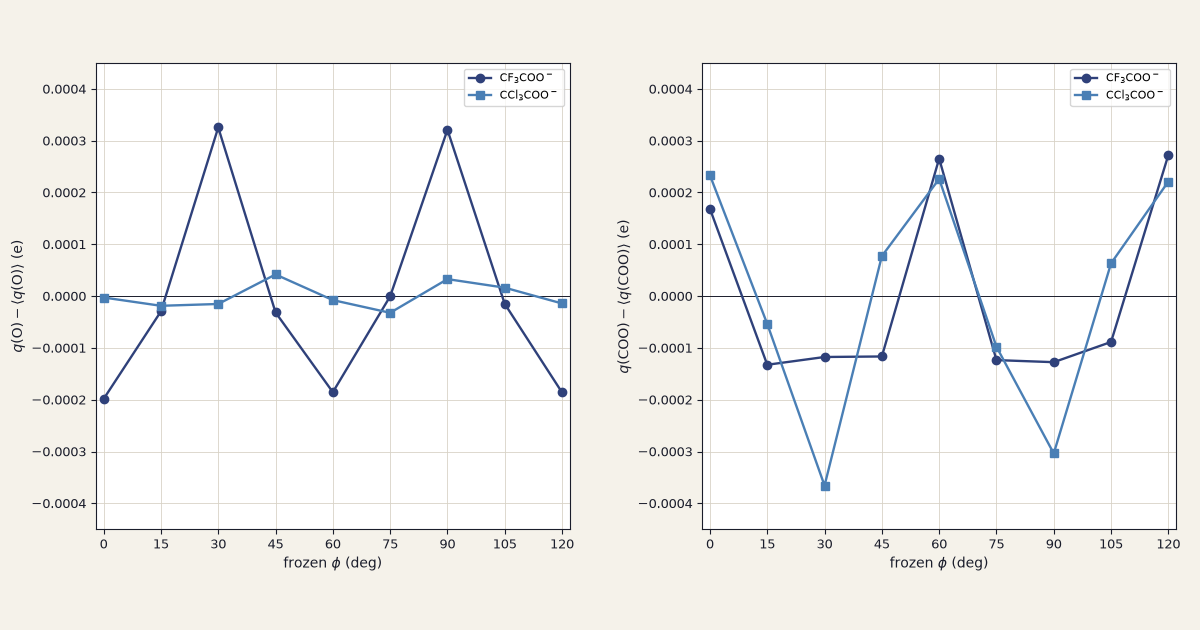
Figure 1. MBIS \(q(\mathrm{O})\) (left) and \(q(\mathrm{COO})\) (right) versus frozen \(\phi\) for CF3COO− (circles) and CCl3COO− (squares), each series as a deviation from its own mean. Absolute scan-mean \(q(\mathrm{O})\), in e, is -0.704 (CF3) and -0.680 (CCl3); scan-mean \(q(\mathrm{COO})\), in e, is -0.790 and -0.578. B3LYP-D3(BJ)/aug-cc-pVDZ. Solid lines join 15° neighbours. All plotted points converged.
Table 2. Peak-to-peak MBIS amplitudes and electronic-energy ranges on the both-converged scan. Conversion is 627.509474 kcal mol\(^{-1}\) \(E_\mathrm{h}^{-1}\). The largest of the four charge amplitudes, in e, is 0.000599. Signed \(120^\circ-0^\circ\) overlays are endpoint-only and are not cited here. Both endpoints on this run converged (true).
| Quantity | CF3COO− | CCl3COO− |
|---|---|---|
| \(q(\mathrm{O})\) amplitude (e) | 0.000524 | 0.000074 |
| \(q(\mathrm{COO})\) amplitude (e) | 0.000405 | 0.000599 |
| \(E\) range (\(E_\mathrm{h}\)) | 4.49×10⁻⁵ | 7.04×10⁻⁵ |
| \(E\) range (kcal/mol) | 0.028 | 0.044 |
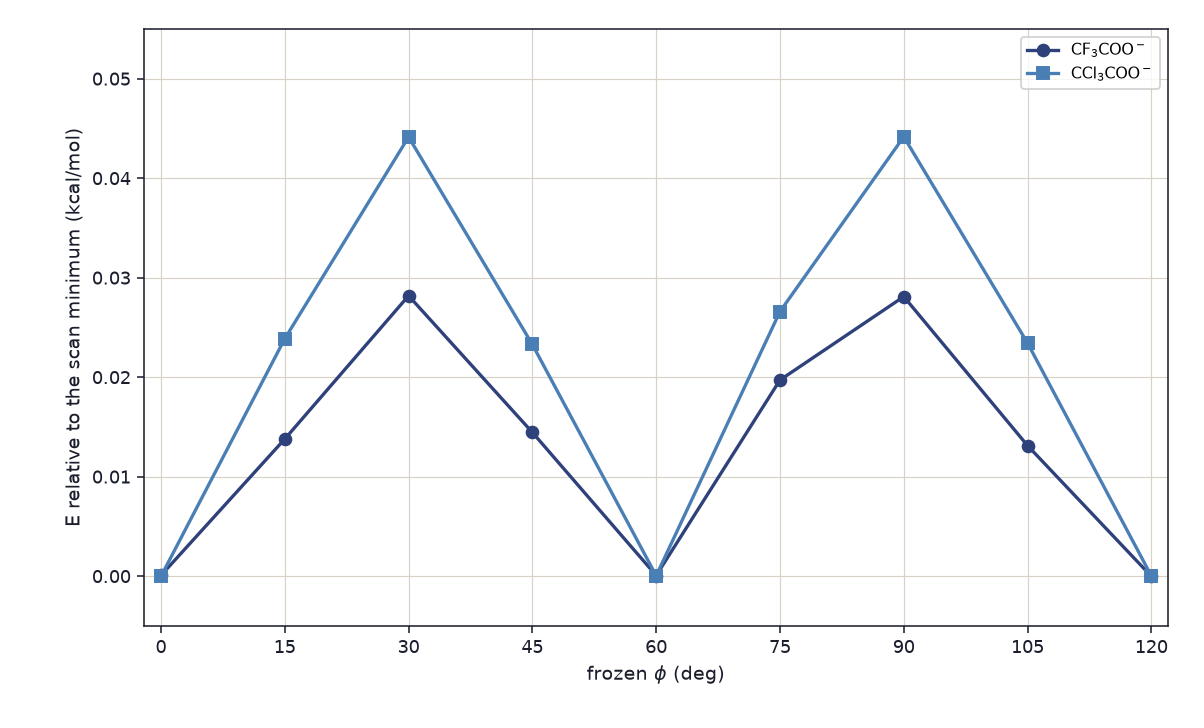
Figure 2. Electronic energy versus frozen \(\phi\), relative to each ion’s scan minimum. CF3COO− circles; CCl3COO− squares. B3LYP-D3(BJ)/aug-cc-pVDZ. Solid lines join 15° neighbours.
The \(q(\mathrm{O})\) comparison CCl3 amplitude \(>\) CF3 amplitude evaluates to false. The \(q(\mathrm{COO})\) comparison evaluates to true. The hypothesis-supported flag, scored on \(q(\mathrm{O})\) after the scan, is false. The registered inconclusive outcome — either ion failing a scheduled grid point — is false. Both-converged finite 0° and 120° endpoints, required before a signed overlay can be projected, are true.
Discussion
The verdict is inconclusive if false, supported if false, and otherwise falsified. On this projection those flags are false and false. On this grid the CCl3 \(q(\mathrm{O})\) amplitude is not larger than the CF3 \(q(\mathrm{O})\) amplitude: 0.000074 versus 0.000524 (e). Falsifier 2 is scored on oxygen charge; the \(q(\mathrm{O})\) comparison is false. \(q(\mathrm{COO})\) is the other way around — 0.000599 versus 0.000405 (e) — and is disclosed here rather than substituted for the named question after the split was seen. The largest of the four amplitudes, in e, is 0.000599. Oscillation, if any, is at that scale. The signed \(120^\circ-0^\circ\) overlay is not the peak-to-peak amplitude. Johnson et al. invited this rotation; they did not publish this amplitude.
After both grids were in hand, on 2026-08-24, we did not pick one
after seeing they split. The question named oxygen charge, so
falsifier 2 is scored on \(q(\mathrm{O})\). \(q(\mathrm{COO})\) is
disclosed alongside. That call is post-scan and is dated in
research/johnson-haloacetate/JOURNAL.md. It is not a silent edit to
the frozen falsifier.
That is as far as the verdict goes. It is a verdict on our hypothesis and our scan. It is not a statement that Johnson et al. were wrong, and it is not a claim that hyperconjugation is absent at their DDEC6/MP2/aug-cc-pVQZ minima.1 Different method, different charge scheme, different question. This scan does not test a \(\mathrm{p}K_\mathrm{a}\) mechanism. If a knowledgeable reader has already seen a larger CCl3 oxygen-charge swing on a comparable rotation, we would rather be told.
The rematch gate was met before the torsion: \(r(\mathrm{C{-}C})\) and \(\Delta(\mathrm{C{-}X})\) run CCl3 \(>\) CF3, and MBIS \(q(\mathrm{O})\) and \(q(\mathrm{COO})\) are more negative for CF3. That is the same qualitative charge order Johnson et al. reported at their level, on a different functional, basis, and partition.1 It is a gate, not a reproduction of their table.
The binding-scheme amendment belongs here, not in Results. After rematch charges were known, and before any torsion, Löwdin on aug-cc-pVDZ reversed the CF3/CCl3 oxygen-charge order and sat near zero while MBIS sat near -0.70408 e / -0.67973 e.9,10 Hirshfeld is absent from this Psi4 build.11 The binding scheme was restricted to MBIS-only on 2026-08-24. The frozen hypothesis and falsifier were not rewritten. A reader who would have kept Löwdin as binding should treat that as a post-observation gate edit and stop there.
The limits that would overturn or shrink this reading are mostly on our side. The method is B3LYP-D3(BJ)/aug-cc-pVDZ, not MP2/aug-cc-pVQZ. The partition is MBIS, not DDEC6. The run is gas-phase. The grid is 15°. The energy ranges, in kcal/mol, are 0.028 and 0.044; a surface that flat can move last-digit charges with grid, optimizer, or BLAS. Acetate was rematched and not scanned, so the “acetate flat” clause of the hypothesis was not tested on a torsion. A DDEC6 or Hirshfeld scan at the 2025 level, or a finer \(\phi\) grid, could move the amplitudes. That would be a different experiment, and we would treat a discrepancy as something to chase through our own setup first.
Conclusion
Under B3LYP-D3(BJ)/aug-cc-pVDZ, MBIS, and gas phase, the registered verdict on the CX3 oxygen-charge hypothesis is inconclusive if false, supported if false, and otherwise falsified. Oscillation of oxygen charge, if any, is 0.000524 (e).
The next experiment on the shelf is not a repair of this scan. The useful follow-up is the same relaxed \(\phi\) grid with DDEC6 at MP2/aug-cc-pVQZ, or with Hirshfeld in a Psi4 build that has it, so that the charge scheme and the wavefunction sit on the footing Johnson et al. actually used.1 Neither has been started. If the right next calculation is a different one, that is information we do not have, and we would like to be told.