
Does a denser 90–105° same-geometry SF-TDA bracket keep the Hillel M4 sign change?
Abstract
Hillel, Rough, Barrett, Pietro, and Mermut (2024), in A cautionary tale of basic azo photoswitching in dichloromethane finally explained, computed 4-phenylazopyridine (AzPy) and its N-protonated form (AzPyH+) with spin-flip time-dependent density functional theory (SF-TDDFT, Tamm–Dancoff) at BH&HLYP-D3(BJ)/def2-QZVPP in ORCA.1 A prior note on this site rematched that electronic-structure level on 4-dimethylamino-4′-nitroazobenzene (M4) as a same-geometry two-root evaluation and found that ΔE = E(T1)−E(S0) changed sign between 90° and 105° on both constrained-CNNC geometry families (2026-08-28 two-root note). Those zeros were linear interpolants of a 15° pair. This note is an independent 5° fill of that rematch: new constrained optimizations and same-geometry two-root single points at 95° and 100°, with the published 90° and 105° two-root points reused.
It is not a rebuttal of the 2024 paper, and it does not reopen the published both-family 90–105° two-root verdict. The registered hypothesis, frozen 2026-09-02 15:30 PDT before any 95° or 100° energy was seen, is that ΔE still changes sign between neighboring both-assigned points inside 90–105° on both families when S0 and T1 are taken from the same SF manifold on one structure.
On both constrained-CNNC geometry families, the same-geometry SF-TDA gap \(E(\mathrm{T1})-E(\mathrm{S0})\) changes sign between 100° and 105°. On the S0-relaxed family the gap is -47.19 kJ/mol at 100° and 21.55 kJ/mol at 105°; the linear interpolant of that pair is 103.43°. On the T1-relaxed family the gap is -47.75 kJ/mol at 100° and 7.22 kJ/mol at 105°; the linear interpolant of that pair is 104.34°. Those interpolants are linear estimates from the 5° pair. The registered hypothesis was supported.
Introduction
Azobenzene and its derivatives change shape around the N=N azo bond. The CNNC dihedral is the torsion that takes the trans isomer (rings opposite, CNNC near 180°) toward the cis isomer (rings on the same side, near 0°). Two electronic states sit on that path. The electronic ground state (S0) is the closed-shell singlet. The lowest triplet (T1) is the lowest state with two unpaired electrons of the same spin. Hillel et al. discuss a crossing as a geometry on the CNNC path where those two states have the same energy.1
Hillel, Rough, Barrett, Pietro, and Mermut computed AzPy and AzPyH+ with SF-TDDFT (Tamm–Dancoff) at BH&HLYP-D3(BJ)/def2-QZVPP in ORCA and found that protonation removes that crossing.1 A later note on this site asked whether M4 still shows a same-geometry two-root sign change of \(E(\mathrm{T1})-E(\mathrm{S0})\) when both roots come from one SF-TDA calculation on one structure (2026-08-28 two-root note). On that window both geometry families changed sign between 90° and 105°. The stored zeros were linear interpolants of those 15° pairs.
The 15° 90–105° pair leaves a wide interval between the last negative and first positive ΔE. This note fills that interval at 5° with new constrained optimizations and same-geometry two-root single points at 95° and 100°, reusing the published 90° and 105° points. We could not find a published 95°/100° same-geometry two-root SF-TDA evaluation of those M4 families. The hypothesis, frozen 2026-09-02 15:30 PDT before any 95° or 100° energy was seen and not rewritten afterward: ΔE still changes sign between neighboring both-assigned points inside 90–105° on both families when S0 and T1 are taken from the same SF manifold on one structure. Three falsifiers were fixed at the same time. (1) Neither family has a both-assigned sign change of same-geometry ΔE on a neighboring pair in 90–105°. (2) A family has a sign change whose interpolant lies outside 90–105°. (3) A family has no neighboring both-assigned pair. The published verdict requires a sign change on both families. If exactly one family changes sign, registered (1) stays false and the both-family hypothesis is not supported; that one-family outcome is scored separately. Either outcome of (1), (2), or (3), or a one-family miss, is publishable. A both-family sign change on a neighboring 5° pair would put the 2026-08-28 zeros on a narrower bracket; a miss would leave the sign change as a property of the 15° pair.
Computational Methods
This is an independent fill of this site’s own published same-geometry rematch. The Hillel et al. 2024 geometries, orbitals, and energy tables were not imported.1 The 90° and 105° single points are the already-published two-root evaluations from the 2026-08-28 note; they were reused and were not re-run. New constrained-CNNC optimizations were run at 95° and 100° on the S0-relaxed family and on the T1-relaxed family, and each new geometry received one SF-TDA single point.
The run uses ORCA 6.1.1; Hillel et al. 2024 used ORCA 5.0.3.1,2 Each geometry received one SF-TDDFT single point (Tamm–Dancoff). S0 is the lowest SF root with \(\langle S^2\rangle\le 0.5\). T1 is the lowest SF root with \(1.5\le\langle S^2\rangle\le 2.5\). Roots outside those bins are unused. Those cuts are the lab operationalization of the freeze’s \(\langle S^2\rangle\approx 0\) / \(\approx 2\) / not-near-1 rule. Assignments follow \(\langle S^2\rangle\), not IROOT. The single-point inputs contain no IROOT keyword. The functional, dispersion, and basis are LibXC(BHANDHLYP) with D3(BJ) and def2-QZVPP.3,4 The Coulomb fit is RIJCOSX with def2/J. The SCF is TightSCF. The run is gas-phase; no polarizable continuum was applied. Charge 0. The SF reference multiplicity is 3. NROOTS is 3. Jobs used %pal nprocs 4 and were started as orca input.inp, never mpirun. No minimum-energy crossing point was located.
\(\Delta E(\varphi,\mathrm{geom})=E(\mathrm{T1})-E(\mathrm{S0})\) is the gap between the two assigned roots on that one structure. Conversion is 1 Eh = 2625.49963831 kJ/mol. A same-geometry sign change is a sign change of ΔE on a neighboring both-assigned pair in 90–105°, scored separately on the S0-relaxed family and on the T1-relaxed family. The linear interpolant of a sign-change pair is recorded. The two family interpolants are not averaged.
The scored dump, conversions, signs, interpolants, and contamination flags were checked against the 2026-09-02 freeze. The committed evidence is research/hillel-m4-sft-dense-bracket/results/dense_bracket_metrics.json. The environment record is research/hillel-m4-sft-dense-bracket/environment.md. Assigned S0 and T1 totals for the new 95° and 100° points are copied from that dump; ΔE on those points is \(E(\mathrm{T1})-E(\mathrm{S0})\) of the assigned roots.
Raw ORCA .out files stay in the private Molecules lab. They are large and carry host paths, and they are treated as scratch in the same way as the 2026-08-28 SF logs. What is committed is the scored dump with pack-relative filenames. The reproducibility label this directory has earned is analysis-reproducible. It is not end-to-end reproducible from this public repository.
Results
8 same-geometry points are both-assigned. Table 1 lists same-geometry ΔE on the S0-relaxed geometries. Table 2 lists the same quantity on the T1-relaxed geometries. The 90° and 105° rows reuse the published two-root single points.
| CNNC (deg) | \(\Delta E\) (Eh) | \(\Delta E\) (kJ/mol) | Source |
|---|---|---|---|
| 90 | -6.872655e-3 | -18.04 | reused |
| 95 | -3.718418e-3 | -9.76 | new |
| 100 | -1.7975e-2 | -47.19 | new |
| 105 | 8.208704e-3 | 21.55 | reused |
Table 1. Same-geometry SF-TDA gap \(\Delta E = E(\mathrm{T1})-E(\mathrm{S0})\) on each S0-relaxed constrained-CNNC geometry. Both roots come from one SF-TDA single point. LibXC(BHANDHLYP)-D3(BJ)/def2-QZVPP, SF-TDA, RIJCOSX, gas phase.
| CNNC (deg) | \(\Delta E\) (Eh) | \(\Delta E\) (kJ/mol) | Source |
|---|---|---|---|
| 90 | -7.502004e-3 | -19.70 | reused |
| 95 | -5.850615e-3 | -15.36 | new |
| 100 | -1.8187e-2 | -47.75 | new |
| 105 | 2.751499e-3 | 7.22 | reused |
Table 2. Same-geometry SF-TDA gap \(\Delta E = E(\mathrm{T1})-E(\mathrm{S0})\) on each T1-relaxed constrained-CNNC geometry. Both roots come from one SF-TDA single point. Same method as Table 1.
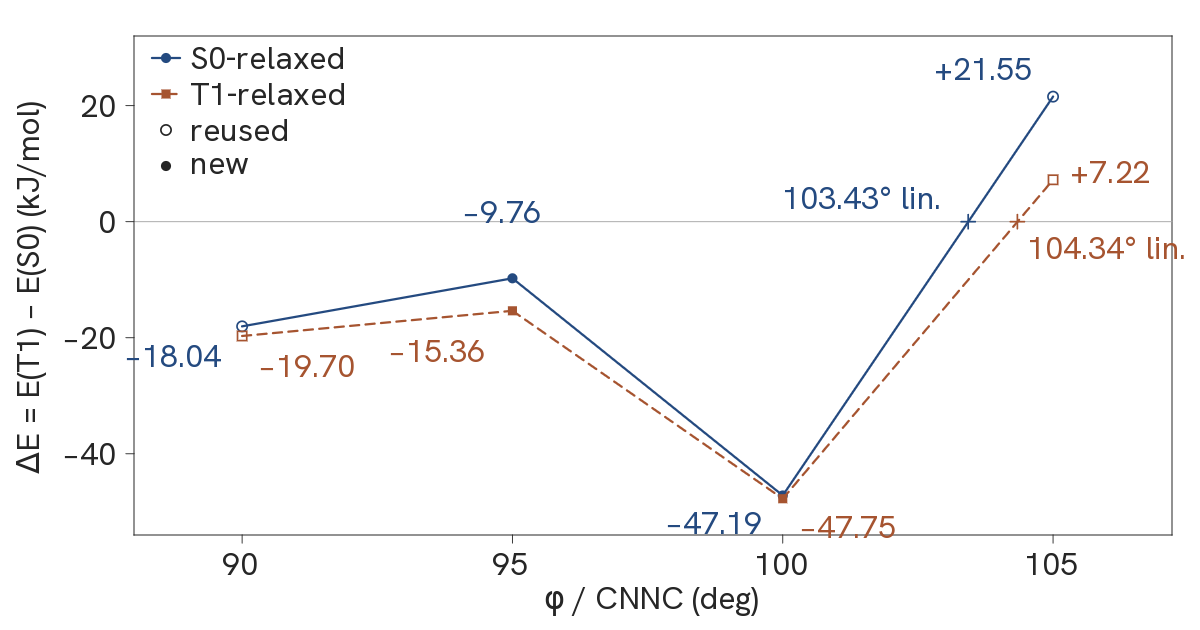
Figure 1. Same-geometry SF-TDA \(\Delta E = E(\mathrm{T1})-E(\mathrm{S0})\) versus CNNC \(\varphi\) on the denser bracket for the S0-relaxed and T1-relaxed families. Open markers are reused published two-root points; filled markers are new points. Plus marks are stored linear estimates of the neighboring sign-change pair spanning 100°–105°, at 103.43° (S0-relaxed) and 104.34° (T1-relaxed). Those interpolants are not MECPs.
On both constrained-CNNC geometry families, the same-geometry SF-TDA gap \(E(\mathrm{T1})-E(\mathrm{S0})\) changes sign between 100° and 105° (Figure 1). The linear interpolant of the S0-relaxed 100°/105° pair is 103.43°. The linear interpolant of the T1-relaxed 100°/105° pair is 104.34°. The 90°/95° pair does not change sign on the S0-relaxed family (-18.04 and -9.76 kJ/mol) or on the T1-relaxed family (-19.70 and -15.36 kJ/mol). The 95°/100° pair does not change sign on either family (-9.76 and -47.19 kJ/mol; -15.36 and -47.75 kJ/mol).
At φ = 100° both families have an unused SF root (true). On the S0-relaxed family that unused root sits near \(\langle S^2\rangle\approx 1\). On the T1-relaxed family unused root 1 lies outside the singlet bin \(\langle S^2\rangle\le 0.5\). Assigned T1 \(\langle S^2\rangle\) at 100° is 1.636 on the S0-relaxed family and 1.837 on the T1-relaxed family (true). At 95° on the S0-relaxed family the assigned S0 \(\langle S^2\rangle\) is 0.437935 (true). The S0-relaxed family has 3 both-assigned neighboring pairs; the T1-relaxed family has 3.
Discussion
The registered hypothesis was supported. Falsifier 1 is false. Falsifier 2 is false. Falsifier 3 is false. The S0-relaxed family flag is true. The T1-relaxed family flag is true. One-family-only sign change is false. On both constrained-CNNC geometry families, the same-geometry SF-TDA gap \(E(\mathrm{T1})-E(\mathrm{S0})\) changes sign between 100° and 105°. Those interpolants are linear estimates from a 5° pair.
That is as far as the verdict goes. It is a verdict on our hypothesis and this window. The 2026-08-28 both-family 90–105° two-root result stays as published. This note narrows that 15° pair with a 5° fill. The 2024 calculation remains SF-TDDFT on AzPy and AzPyH+.1 If a knowledgeable reader has already seen this denser same-geometry sign change on M4 at a comparable SF-TDDFT level, we would rather be told.
Assigned T1 \(\langle S^2\rangle\) at 100° is 1.636 (S0-relaxed) and 1.837 (T1-relaxed). Those values sit in the triplet assignment bin used here (\(1.5\le\langle S^2\rangle\le 2.5\)) and outside the 2026-08-28 published residual 2.19–2.29. Assigned S0 \(\langle S^2\rangle\) at 95° on the S0-relaxed family is 0.437935, in the singlet bin \(\langle S^2\rangle\le 0.5\) and outside the published residual 0.14–0.31. At 100° the S0-relaxed unused root sits near \(\langle S^2\rangle\approx 1\); the T1-relaxed unused root 1 lies outside the singlet bin. The 100° assignments still follow \(\langle S^2\rangle\). Residual SF contamination on those new points is larger than the eight-point window published in 2026-08-28.
The limits that would overturn or shrink this reading are mostly on our side. The program is ORCA 6.1.1, not 5.0.3. The functional is LibXC(BHANDHLYP). The run is gas-phase; dichloromethane, the solvent of the 2024 experiments, is absent. Residual SF contamination is larger at 95° and 100° than on the reused 90° and 105° points. The zeros are linear interpolants of a 5° pair. An MECP search on the same SF surfaces, a solvent model, or a native-functional repair could move or remove those interpolants. We would treat a discrepancy as something to chase through our own setup first.
Conclusion
Under ORCA 6.1.1 SF-TDA LibXC(BHANDHLYP) D3BJ/def2-QZVPP (RIJCOSX, gas phase), the same-geometry SF-TDA gap \(E(\mathrm{T1})-E(\mathrm{S0})\) of constrained-CNNC M4 changes sign between 100° and 105° on both geometry families after a 5° fill of the 90–105° window. On the S0-relaxed family the gap is -47.19 kJ/mol at 100° and 21.55 kJ/mol at 105°, with linear interpolant 103.43°. On the T1-relaxed family the gap is -47.75 kJ/mol at 100° and 7.22 kJ/mol at 105°, with linear interpolant 104.34°.
The next experiment is an MECP search on the same SF surfaces near those interpolants. Keep S0 and T1 as two roots from one SF manifold, and ask whether a located crossing sits near 103.43° on the S0-relaxed family and near 104.34° on the T1-relaxed family.