
#push-pull chromophores
Every note tagged #push-pull chromophores, newest first — or browse the full archive.
Does a denser 90–105° same-geometry SF-TDA bracket keep the Hillel M4 sign change?
A 5° fill of this site's 2026-08-28 same-geometry two-root rematch of Hillel, Rough, Barrett, Pietro, and Mermut (2024) SF-TDA on 4-dimethylamino-4′-nitroazobenzene. The parent note's both-family sign change sat on a 15° 90–105° pair. This note narrows that pair with new constrained optimizations and same-geometry two-root single points at 95° and 100°.
Does the 2026-08-27 Hillel M4 SF profile-gap survive a same-geometry two-root rematch under Hillel 2024 SF-TDDFT?
An independent same-geometry two-root rematch of this site's 2026-08-27 Hillel M4 SF-TDA geometries at the Hillel, Rough, Barrett, Pietro, and Mermut (2024) electronic-structure level. The parent note's sign change was a separately relaxed profile gap. This note asks whether ΔE = E(T1)−E(S0) still changes sign when both roots come from one SF manifold on one structure.
Does Hillel M4 still show an S0/T1 crossing near 110° under Hillel 2024 SF-TDDFT?
An independent rematch of Hillel, Rough, Barrett, Pietro, and Mermut (2024) SF-TDDFT on 4-dimethylamino-4′-nitroazobenzene. The published 2026-08-22 RKS/UKS note found a both-converged S0/T1 sign change on this dye. This note asks whether that crossing remains when S0 and T1 are taken from the SF-TDDFT manifold at the 2024 electronic-structure level.
Does Hillel's 2024 push-pull sentence hold for 4-dimethylamino-4′-nitroazobenzene?
An independent RKS/UKS B3LYP-D3(BJ)/cc-pVDZ CNNC torsion scan of an untested 2024 generalization — that push-pull azobenzenes, like protonated AzPyH+, would lose the S0/T1 crossing along the azo twist. The test case is 4-dimethylamino-4′-nitroazobenzene, with azobenzene, AzPy, AzPyH+, and 2-phenylazopyridine as controls.
How the donor closes the gap: para-substituent effects in a minimal push-pull dye
A four-point series of para-X-benzylidenemalononitriles (X = H, F, NH₂, NMe₂) shows how donor strength moves the HOMO and LUMO, and explains why para-fluorine acts as a weak net donor in this minimal push-pull scaffold.
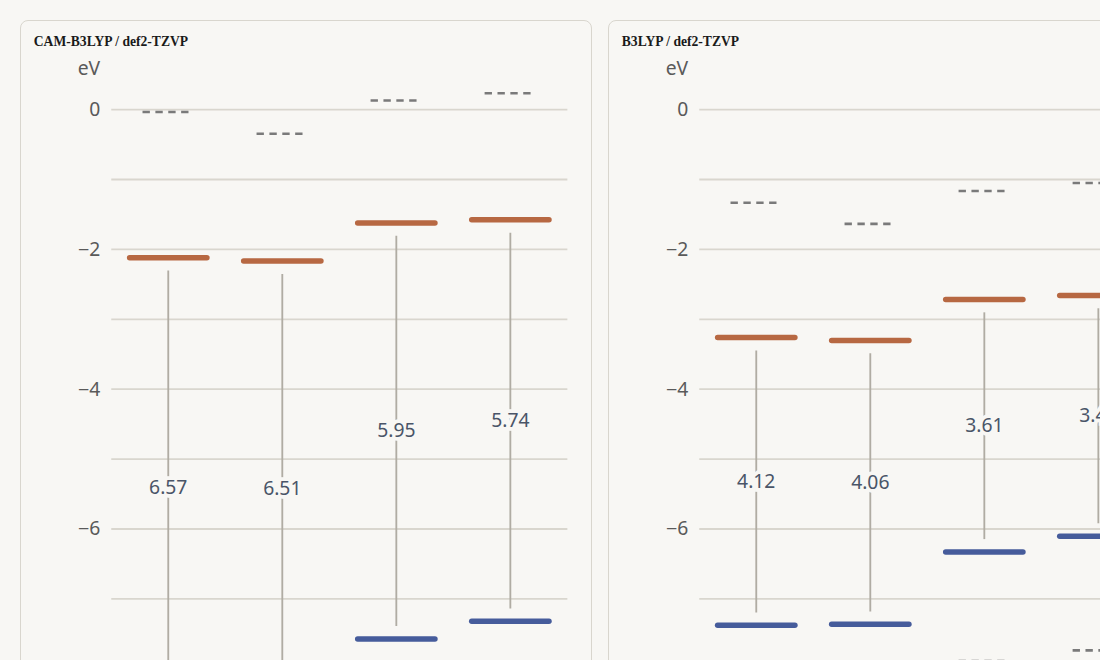
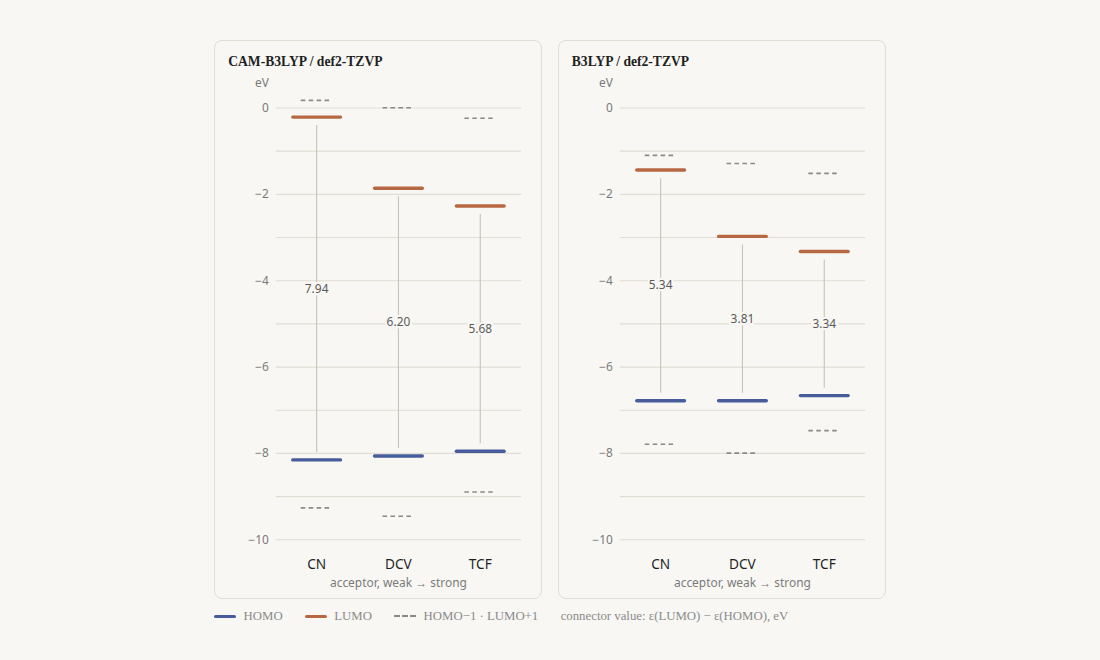
How the acceptor closes the gap: acceptor-strength effects in para-methoxy push-pull dyes
A three-point series of para-methoxy push-pull dyes with CN, DCV, and TCF acceptors shows how acceptor strength moves the HOMO and LUMO, and how the HOMO-LUMO gap closes as the acceptor strengthens.
One dye, one transition: how DCDHF-Me2 earns the two-level picture
The blinking-to-absorption note modeled a fluorescent dye as two levels and named what that hides. Computing the actual excited-state manifold of DCDHF-Me2 — a push-pull dye engineered for single-molecule imaging — gives a sharper answer than we planned. Its visible absorption is essentially one transition, and the rest of the manifold lives in the deep UV; benzene, the dye's own parent ring, shows the opposite arrangement for a reason symmetry makes plain.
One donor, one acceptor, one new band: push–pull chromophores and charge transfer
Aniline and nitrobenzene each absorb only in the ultraviolet. Bolt the amino donor and the nitro acceptor onto the same ring and a new band appears that neither parent owns — lower in energy and brighter than anything either shows alone. This post computes that emergence with TD-DFT, measures the charge-transfer character directly, and uses it to stress-test two density functionals against a failure mode one of them is famous for.