
One muon, two frames, and the workflow that parked itself
This note explains two machines with one demonstration. The first machine is special relativity’s simplest working example: a muon created high in the atmosphere survives to a detector that a naive calculation — the full laboratory path at the same speed but with the undilated lifetime — says it should essentially never reach, and two reference frames give two different accounts of why it does — time dilation in one, length contraction in the other — that must and do agree. The second machine is the research workflow that this site briefly ran: an append-only ledger of reviewed handoffs between separated roles, built to make a computer experiment’s provenance inspectable. The muon calculation was deliberately chosen as the smallest possible cargo to push through that machinery as an acceptance trial. The route through this note follows the dependency order: first the physics, then the workflow that carried it, then the ledger’s own record of what that cost, and finally the place where the workflow stopped and what stopping revealed. Neither machine gets a verdict — this is a description of how each works, with the boundary stated at the end.
One decay, two descriptions
A muon at fixed momentum decays with proper mean lifetime \(\tau_0\); the Particle Data Group central values used here are \(\tau_0 =\) 2.196981×10⁻⁶ and a mass energy of 105.6583755 MeV.1 The demonstration freezes an idealized muon at 3.00 GeV/c momentum traversing 15000.0 of atmosphere, decay-only, with no scattering or energy loss. Survival over a proper time \(t\) is exponential:
\[ P = \exp(-t/\tau_0). \]
Every quantity below reconstructs from the three declared inputs — momentum \(p\), mass energy \(mc^2\), and laboratory path \(L\) — through \(\gamma\beta = pc/(mc^2)\), \(t_D = L/(\beta c)\), \(L' = L/\gamma\), and \(t_M = L'/(\beta c)\). The two frames route to the proper time differently.
Detector frame. The muon moves at \(\beta =\) 0.99938037, so \(\gamma =\) 28.41099936. The laboratory crossing takes \(t_D =\) 5.006564×10⁻⁵. The moving muon’s lifetime is dilated to \(\gamma\tau_0 =\) 6.241843×10⁻⁵, and the dimensionless decay exponent is \(t_D/(\gamma\tau_0) =\) 0.80209703.
Muon frame. The muon is at rest and the atmosphere rushes past at the independently reconstructed \(\beta =\) 0.99938037 (\(\gamma =\) 28.41099936). The path is contracted to \(L/\gamma =\) 527.964533, crossed in proper time \(t_M =\) 1.762192×10⁻⁶ against the undilated lifetime \(\tau_0\). The exponent is \(t_M/\tau_0 =\) 0.80209703.
The two exponents are the same physical quantity computed along two routes — one proper time, two coordinate descriptions, not two causal mechanisms. At the eight digits displayed here they coincide — 0.80209703 against 0.80209703 — and the stored binary64 values differ by exactly one representable step, at the sixteenth digit, within the registered relative tolerance; Figure 2 prints both in full. Analytic survival is 44.839%. A registered Monte Carlo sample of 100,000 proper lifetimes (PCG64, seed 20260808) gives 44859 survivors at the focal distance, an empirical survival of 44.859% — a standardized discrepancy of 0.129 binomial standard errors, an implementation check of the assumed exponential law rather than independent physics. The counterfactual with the same speed but no lifetime dilation survives at 1.268×10⁻¹⁰: essentially no muon would arrive. That contrast is the classic Frisch–Smith measurement’s logic, run as an idealized calculation rather than an experiment on real flux.2
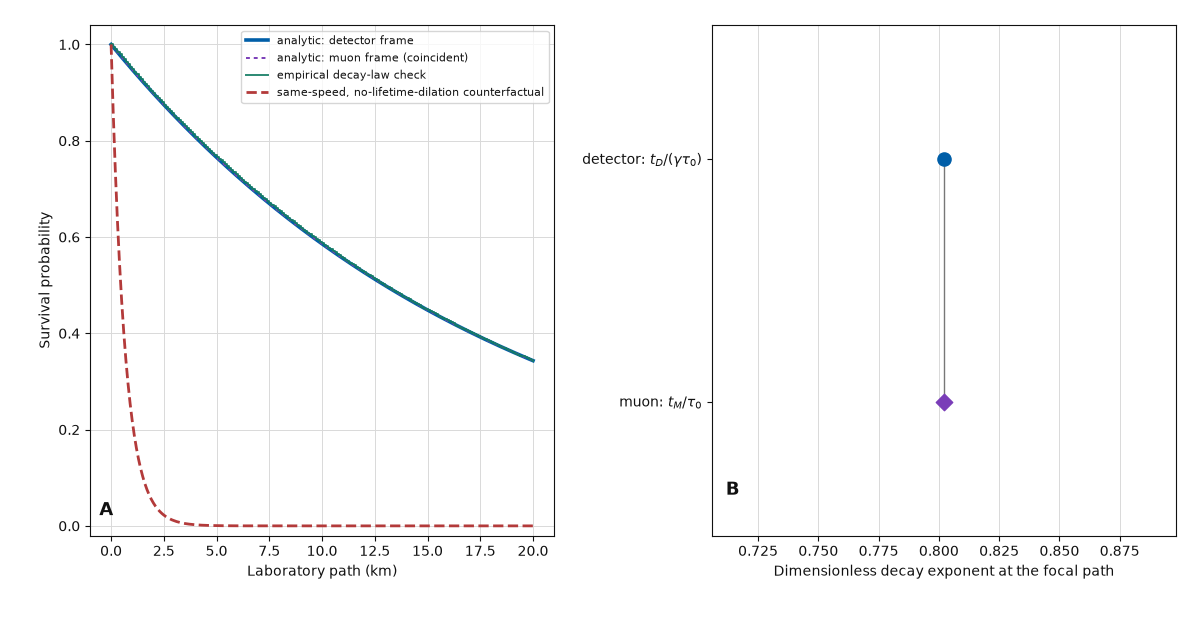
Figure 1. The registered v1 figure, byte-preserved from the workflow trial. A: analytic survival in both frames (coincident curves), the empirical decay-law check, and the same-speed no-lifetime-dilation counterfactual collapsing to zero within a few kilometres. B: the two frame decay exponents as aligned markers on the common dimensionless axis. Panel B is the panel the workflow’s analysis review rejected: it aligns the exponents but does not print the frame-specific distances and times that make the two routes different. This note returns to that rejection below.
The machine that carried it
The calculation above needs about a minute of computer time. The interesting
machinery is what surrounded it: a coordination graph this repository ran as
research-workflow.mjs, retired earlier this week and preserved for this note
in the experiment’s own directory under
graph/,
together with its state graph
and its protocol document.
The design has four load-bearing ideas.
Roles that cannot see each other’s work. The graph separates a brainstormer, an experiment engineer, a run operator, an analyst, and independent reviewers. The run operator executes the frozen command once and seals the outputs without analyzing, plotting, or tuning; reviewers must present a different actor identity than the producer they are checking. The intent is that no single context can both produce a result and certify it.
An append-only ledger. Every submission and review appends one JSON event
to workflow.jsonl; no
event is ever edited. Each event names the graph node it leaves, the node it
enters, the actor, and a decision — approve, revise, amend, or park. Code 1
shows the trial’s terminal event.
Code 1. Fields from the ledger’s final event: an independent amendment
reviewer routes the experiment from amendment_review to the terminal
parked state. The full event also carries a UUID, a timestamp, the SHA-256
of the governing graph, and the evidence snapshot it binds.
{
  "sequence": 27,
  "type": "review",
  "actor": "amendment-reviewer-muon-14",
  "role": "independent_reviewer",
  "from": "amendment_review",
  "to": "parked",
  "decision": "park"
}
Evidence bound by hash. A submission is not prose in a chat window; it is
a small receipt file, snapshotted immutably under
workflow/
with its SHA-256 recorded in the ledger event. The approved setup manifest
hash-binds the renderer; the admitted run hash-binds the setup manifest; every
ledger event records the SHA-256 of the graph it obeyed. The chain means a
later reader can verify, not merely trust, which bytes each approval covered.
Deterministic replay. The CLI’s verify command replays the entire ledger
against the graph’s rules and every snapshot’s hash. Replayed under the
retired engine while preparing this note, this trial’s ledger still validates:
27 events, 26
snapshots, terminal state parked.
What the ledger recorded
The ledger is itself a dataset, and this note’s metrics derive from it the same way the physics metrics derive from the run summary. The trial ran 4.6 from initialization to terminal event, in 27 events: 13 submissions and 13 independent reviews, of which 8 sent work backward.
The concentration of those revisions is the striking part. Setup review alone
ran 7 rounds before execution was
permitted. The findings were real — the trial’s own retrospective lists
non-atomic file publication, replay defects, and time-of-check gaps among
them — but nearly all concerned the workflow’s own hardening requirements
rather than the muon. The generator that those reviews produced wrote one
small JSON file through a staged, fsynced, hardlink-quarantine protocol, and
is preserved as part of the specimen
(graph/hardened-generate-metrics.mjs);
it also shelled out to a local Python environment that exists on no other
machine, so the first continuous-integration run would have failed it. The
canonical science under all of this was one 100,000-draw sample, 201 grid
points, and one figure.
Execution itself, by contrast, was clean and brief: one run, sealed and admitted on review without result inspection, exactly as designed. The analysis reviews then did the most genuinely scientific work of the trial: the first rejected panel B of Figure 1 for aligning the two exponents without printing the frame-specific distances and times — a real fidelity gap between the figure and its stated purpose.
The amendment with no edge
Fixing panel B changes no number, no seed, no curve, and no claim. It is a
presentation-only correction: re-render one panel from the unchanged,
already-admitted results/summary.json. But the approved setup manifest
hash-bound the v1 renderer, so editing it would break the very chain that made
the run trustworthy, and graph v1’s only post-exposure route — amendment,
amendment review, amended setup, re-execution — requires a fresh run lineage.
The amendment receipt
that the trial filed is explicit that every available move was unlawful:
rerunning would violate the one-run rule for a change that needs no run;
editing the renderer would violate the hash binding; calling the old run’s
validation a “new execution” would satisfy the graph by lying to it. The
independent amendment reviewer agreed and parked the experiment.
The retired CLI’s status output for this
experiment still ends: “Allowed: none; merge or close the parked work
externally.”
That is a workflow-valid stop and an honest one — every actor followed the rules, and the rules had no edge for a cosmetic fix. The trial’s retrospective called this the blocker: the graph could not distinguish a presentation change from a scientific one, so it priced both at a full new run lineage, and a figure label became terminal.
The corrected panel, one script later
This note is published under the repository’s successor pipeline — branch,
automated checks, pull request, continuous integration — which replaced the
graph. Under it, the parked correction took one small reviewed script:
src/render_figure_v2.mjs,
the artifact the amendment receipt named but could not lawfully create. It
keeps the control that mattered — every printed value is read from the
unchanged canonical results/summary.json at render time, never typed by
hand — and drops the machinery that did not: no manifest rebinding, no new
run, no state machine. Figure 2 is its output.
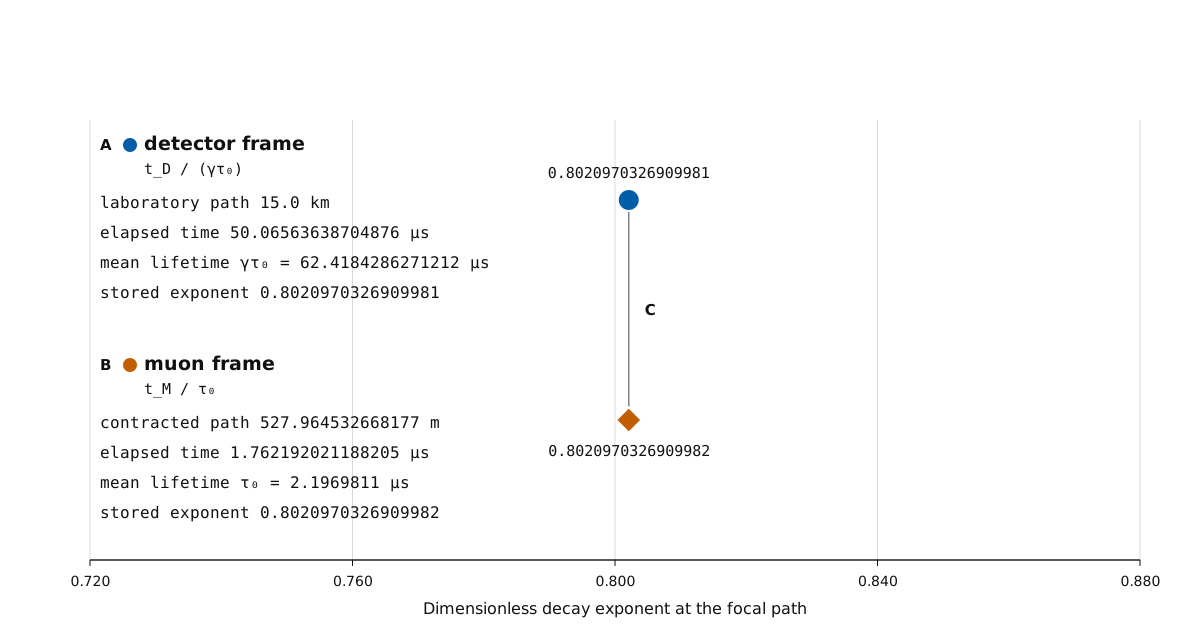
Figure 2. The corrected panel-B presentation. A: the detector route — laboratory path, elapsed time, dilated mean lifetime, and its stored exponent. B: the muon route — contracted path, proper time, proper lifetime, and its stored exponent. C: the two markers on the common dimensionless axis, aligned because the printed sixteen-digit exponents differ only at the final digit, within the registered relative tolerance. Both stored values are printed unaltered rather than replaced by a shared rounded value. The muon route is drawn in orange rather than Figure 1’s purple because the v1 blue–purple pair fails a color-vision-deficiency separation check — a defect 7 rounds of setup review did not look for.
Where the model stops
Each machine has a boundary, and stating them is the point of this note.
The physics demonstration establishes coordinate consistency, not new physics: one proper time, two bookkeeping routes, an idealized fixed-momentum muon with decay as the only process. It predicts no real atmospheric flux and measures nothing; the Monte Carlo checks the implementation, not nature.
The workflow’s boundary is subtler. What it can establish is process integrity: that specific bytes passed specific reviews in a specific order, that no result was tuned after exposure, that a reader can replay the whole claim. What it cannot establish is proportion or meaning. Actor identities are self-asserted labels, so role separation is a discipline the operators chose to honor, not a fact the ledger can prove. The graph cannot tell a cosmetic change from a scientific one, which is exactly how a figure label became a terminal state. And its cost scales with its own machinery rather than with the science it carries: the ledger’s hours were spent almost entirely on the carrier, not the cargo. This repository retired the graph for that reason; the values this note reports are the trial’s exposed v1 results, published here with that lineage disclosed rather than under an approved graph descent. The retirement is a proportionality judgment, not a refutation — nothing in this note shows the controls failing; it shows them costing more than a small demonstration can carry. A consequential, adversarial, or multi-machine experiment could still rationally choose machinery like this, ideally with the reduced presentation-amendment lane whose absence parked this trial.
Reproducibility
The canonical run executed once on 2026-08-09 under the pinned environment in
environment.md and
requirements.lock.txt
(CPython 3.12.3, NumPy 2.5.1, binary64 throughout; PCG64 seed 20260808), via
the frozen command recorded in the experiment
README. Its sealed sample and
manifests are committed under runs/run-001/. From the committed outputs,
stock Node.js regenerates everything this note displays:
research/muon-survival-two-frames/generate-metrics.mjs rebuilds
metrics.json from results/summary.json and workflow.jsonl, and
src/render_figure_v2.mjs rebuilds Figure 2 from results/summary.json.
Both support --check, and the metrics generator’s check also replays the
figure check, so continuous integration exercises both on every build.
Figure 1 is the byte-preserved v1 PNG and is deliberately not regenerated.
Those are projection- and presentation-level regenerations, and the earned
label is traceable — not analysis-reproducible. Regenerating
results/summary.json itself from the sealed sample requires the pinned
Python environment plus a restored verifier layout: src/analyze.py invokes
the hash-bound workflow verifier at its original repository paths, and no
single commit contains both this experiment and that verifier, because the
trial branch merged after the retirement. The preserved graph/ copies are
byte-identical to the retired originals, so the restoration is copying two
files back to their old paths in a scratch clone, as the experiment README
describes. The ledger replay reported above ran against the same restored
layout.