
Does force training move where Coulomb subtraction helps an H2+ neural potential?
Revised twice since publication — once for a Methods description that did not match the committed code, once for a training-loop defect that required re-running the experiment. Both crossover cutoffs are unchanged. See Revisions for what was wrong, how it surfaced, and what moved.
Abstract
Rana, Manoj, Lourderaj, and Sathyamurthy, in Artificial Neural Networks Fitting of Potential Energy Curves and Surfaces: The 1/R Conundrum (J. Comput. Chem. 46, 2025, e70220), fit molecular potentials by subtracting the exact nuclear repulsion, fitting the smoother electronic energy, and restoring the exact term afterward.1 A companion note here measured, on the one-electron H\(_2^+\) curve, that this decomposition helps a small network only on a fitting domain that reaches the short-range repulsive wall, and stops helping once the domain begins beyond the minimum. That experiment fit energies alone. Because the subtracted term is \(1/R\) while the nuclear contribution to the force is the steeper \(1/R^2\), a natural question is whether training on forces as well as energies moves the cutoff at which subtraction stops paying. I refit an analytic minimal-basis LCAO H\(_2^+\) curve with matched folds, seeds, and budgets, under an energy-only loss and under an energy-plus-force loss, for a direct total-energy target (Scheme A) and an electronic-energy target with exact \(1/R\) restoration (Scheme B). The energy-only crossover cutoff is 3.0 \(a_0\). Under the energy-plus-force loss the crossover is 2.0 \(a_0\). The predeclared hypothesis — that force labels push the crossover to a larger cutoff — was falsified: the crossover moved to a smaller cutoff. Adding force labels widened the subtraction advantage against the wall, where the median direct-fit error ran to 1830.36 times the subtraction-fit error, while moving the crossover inward — indicating that the range over which subtraction helps is set by the energy target’s short-range curvature rather than extended by the force channel.
Introduction
A neural network that fits a molecular potential energy curve must reproduce a function that is smooth over most of its domain but rises steeply as two nuclei approach, because the nuclear repulsion diverges as \(1/R\). Behler and Parrinello established the template of representing a potential energy surface with a neural network,2 and a recurring practical difficulty is that this \(1/R\) wall dominates the target’s dynamic range and forces the network to spend capacity on a term whose functional form is already known exactly. Rana and co-workers named this the \(1/R\) conundrum and proposed a direct remedy: at fixed nuclei a potential separates as
\[ V(\mathbf R) = E_{\mathrm{el}}(\mathbf R) + V_{\mathrm{NN}}(\mathbf R), \qquad V_{\mathrm{NN}} = \sum_{A<B}\frac{Z_A Z_B}{R_{AB}}, \]
so one can subtract the exact \(V_{\mathrm{NN}}\), fit the smoother electronic energy \(E_{\mathrm{el}}\), and add the exact term back afterward.1
A preceding note in this series (where Coulomb subtraction helps) took the one-electron H\(_2^+\) curve as a controlled setting and asked not whether the decomposition works but where it helps a small network. Its answer was a crossover in bond distance: subtracting \(1/R\) is a strong conditioning choice when a single fit must cover the repulsive wall, and the advantage disappears once the fitted domain starts beyond the equilibrium separation, where the electronic energy and the total potential are comparably smooth targets. That experiment fit energies only.
Potentials, though, are rarely fit for their own sake; the quantity that drives dynamics is the force, \(-\nabla V\). Fitting energies and forces together is standard practice — Pukrittayakamee and co-workers fit a surface and its gradients simultaneously with feed-forward networks,3 and gradient labels are now understood to carry most of the information about a potential’s shape.4 This is where the energy-only crossover leaves a gap. The subtracted term is \(V_{\mathrm{NN}} = 1/R\), but its contribution to the force is \(-\mathrm{d}(1/R)/\mathrm{d}R = 1/R^2\), which is steeper still and concentrated even more tightly against the wall. If the network in the direct scheme must now also reproduce that \(1/R^2\) force, one would predict its disadvantage near the wall to grow, so that the electronic-fit scheme keeps its edge over a wider range of domains — the crossover should move to a larger cutoff. Whether it actually does is not something either the parent note or Rana et al. measured, because neither trained on forces.
I therefore state the hypothesis before the experiment: under an energy-plus-force loss the crossover cutoff — the smallest fitting-domain lower bound at which subtracting \(1/R\) no longer improves the fit — is larger than under an energy-only loss. The falsifier, fixed in advance, is that the first cutoff at which the direct scheme matches or beats the subtraction scheme is unchanged or moves to a smaller cutoff once force labels are added. Either outcome is worth reporting: a crossover that moves would separate a specific force-channel effect from the energy conditioning the parent note found, and a crossover that does not move would show the conditioning benefit is a property of the energy target alone.
Computational Methods
Reference curve. The H\(_2^+\) potential is generated analytically, not with an electronic-structure package. Each proton carries one \(1s\) Slater function with exponent \(\zeta = 1\); the symmetric (bonding, \(1s\sigma_g\)) molecular-orbital energy follows from the closed-form two-centre integrals over \(1s\) functions,5
\[ S = e^{-R}\!\left(1 + R + \tfrac{R^2}{3}\right),\quad J = \tfrac1R - e^{-2R}\!\left(1 + \tfrac1R\right),\quad K = e^{-R}(1 + R), \]
\[ E_{\mathrm{el}}(R) = -\tfrac12 - \frac{J + K}{1 + S}, \qquad V(R) = E_{\mathrm{el}}(R) + \frac1R, \]
in hartree, with \(R\) the internuclear distance in bohr. This minimal-basis model is deliberately crude: its minimum sits at \(R_e = 2.49\,a_0\) with a binding energy of \(0.065\) hartree, further out and shallower than the exact H\(_2^+\) values, and it is not the UHF/aug-cc-pV5Z curve of the parent note. It is used here as a self-contained target with the qualitative structure the question needs — a \(1/R\) repulsive wall, a bound minimum, and dissociation to \(-\tfrac12\) hartree — so that the two loss functions are compared on one and the same curve. The analytic derivative \(\mathrm{d}V/\mathrm{d}R\), used to build force labels, is verified against complex-step differentiation to a maximum relative error below \(10^{-10}\) across the grid, and the tabulated integral values are checked at \(R = 2\,a_0\). The curve is evaluated at 401 geometrically spaced distances from \(0.15\) to \(20\,a_0\).
Two schemes. Scheme A fits the total potential \(V(R)\) directly. Scheme B fits the electronic energy \(E_{\mathrm{el}}(R) = V - 1/R\) and restores the exact \(1/R\) term before the prediction is scored. Under force training the exact nuclear force enters earlier, and by subtraction rather than restoration: Scheme B’s slope label is \(\mathrm{d}E_{\mathrm{el}}/\mathrm{d}R = \mathrm{d}V/\mathrm{d}R + 1/R^2\), so the \(1/R^2\) term is removed from what the network has to learn instead of being added back afterwards. Both schemes are scored the same way, on the total potential, and the score is an energy RMSE — no predicted force is evaluated.
Two losses. The energy-only loss is the mean squared error of the standardised value target. The energy-plus-force loss adds the mean squared error of the standardised slope, \(L = \mathrm{MSE}(\text{value}) + \lambda\, \mathrm{MSE}(\text{slope})\), with \(\lambda = 1\) fixed in advance. Each scheme standardises and differentiates its own target: Scheme A trains on \(V\) and \(\mathrm{d}V/\mathrm{d}R\), Scheme B on \(E_{\mathrm{el}}\) and \(\mathrm{d}E_{\mathrm{el}}/\mathrm{d}R\), so the exact nuclear terms enter Scheme B twice: analytically in its labels during training, and as the \(1/R\) energy restoration at scoring. Slopes are expressed in each target’s standardised coordinates so the two error channels are comparable.
Network and optimisation. Both schemes use a one-hidden-layer network with 15 \(\tanh\) units and a linear readout, float64 arithmetic, Xavier-uniform weights, and zero biases. The single input \(R\) is standardised from the training-fold mean and standard deviation; each target is standardised from its own training-fold moments and returned to hartree before scoring. Optimisation is full-batch Adam \((0.9, 0.999, 10^{-8})\) for 20,000 steps with cosine learning-rate decay from \(10^{-3}\) to \(10^{-5}\) and no regularisation; the checkpoint with the lowest training objective is retained. This matched, paired construction follows the comparison discipline of the earlier neural-network notes in this series (why the two SIREN conventions train differently).
Gradients. The network is small enough that the value and slope gradients with respect to every weight are written analytically, including the mixed second-derivative terms the slope loss introduces. They are checked against central finite differences to a maximum relative error below \(10^{-5}\) before the sweep runs, and a batched trainer that fits all 25 networks of a cutoff at once is checked against the unbatched reference on random inputs.
Cutoffs, folds, seeds, and the metric. For each lower cutoff \(R_{\min}\) in \(\{0.15, 0.25, 0.40, 0.70, 1.00, 1.50, 2.00, 3.00\}\,a_0\), only points with \(R \ge R_{\min}\) are retained; each cutoff defines its own fit and evaluation domain. Five stratified folds are assigned once on the full ordered grid with a seed-70220 permutation inside each consecutive five-point block and preserved across cutoffs. Five initialisation seeds (11, 29, 47, 71, 101) are used; within a fold and seed, Schemes A and B and the two losses all start from bit-identical weights. Every eligible point receives one out-of-fold prediction; the primary metric is the pooled out-of-fold energy RMSE in cm\(^{-1}\). Per seed the paired ratio is \(\mathrm{RMSE}_A/\mathrm{RMSE}_B\); the reported value at each cutoff is the median over the five seeds. The crossover cutoff is the smallest \(R_{\min}\) whose median ratio is at most one.
First-hand scope. Every number here is generated by the committed NumPy code; no program, code, or data from Rana et al. was used, and this is an independent controlled test on a different H\(_2^+\) curve, not a numerical reproduction of their tables. The experiment runs on a computer with no living subjects. It is end-to-end reproducible: the deterministic, seeded sweep regenerates the results table, and the metrics projection is regenerated and fingerprint-verified from it.
Results
Table 1 lists the median paired A/B out-of-fold energy-RMSE ratio at every cutoff under both losses, and Figure 1 plots them.
| \(R_{\min}\) (bohr) | energy-only A/B | energy+force A/B |
|---|---|---|
| 0.15 | 53.37 | 1830.36 |
| 0.25 | 21.74 | 212.41 |
| 0.40 | 12.16 | 23.84 |
| 0.70 | 10.75 | 8.92 |
| 1.00 | 10.01 | 5.77 |
| 1.50 | 1.78 | 3.07 |
| 2.00 | 1.70 | 0.26 |
| 3.00 | 0.58 | 0.33 |
Table 1. Median paired A/B out-of-fold energy-RMSE ratio at each fitting-domain lower cutoff, under the energy-only and energy-plus-force losses. A value above one is a cutoff at which the median direct-fit (Scheme A) RMSE exceeds the median Coulomb-subtraction (Scheme B) RMSE.
Under the energy-only loss the median ratio ran from 53.37 at \(R_{\min} = 0.15\,a_0\) to 0.58 at \(3.00\,a_0\), first at or below one at a cutoff of 3.0 \(a_0\). Under the energy-plus-force loss the median ratio ran from 1830.36 at \(0.15\,a_0\) to 0.33 at \(3.00\,a_0\), first at or below one at 2.0 \(a_0\) (Figure 1). At \(R_{\min} = 0.15\,a_0\) under the energy-only loss the median Scheme A RMSE was 27113 cm\(^{-1}\) and the median Scheme B RMSE was 525 cm\(^{-1}\).
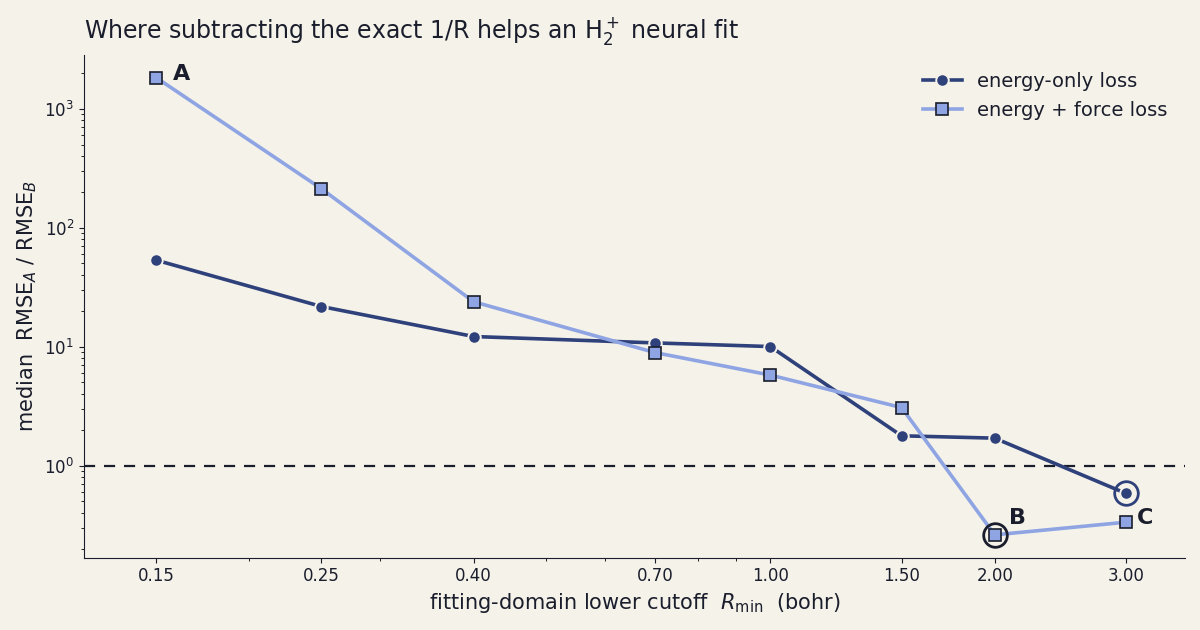
Figure 1. Median paired A/B out-of-fold energy-RMSE ratio versus fitting-domain lower cutoff for the energy-only loss (dark circles) and the energy-plus-force loss (light squares); the dashed line marks a ratio of one. A marks the shortest cutoff, \(R_{\min} = 0.15\,a_0\); B marks the smallest cutoff at which the energy-plus-force ratio is at most one, \(R_{\min} = 2.00\,a_0\); C marks the smallest cutoff at which the energy-only ratio is at most one, \(R_{\min} = 3.00\,a_0\).
Discussion
The predeclared hypothesis was falsified. Force training did move the crossover, but in the direction the registered falsifier named: the smallest cutoff at which the direct fit caught the subtraction fit fell from 3.0 \(a_0\) under the energy-only loss to 2.0 \(a_0\) under the energy-plus-force loss. The range of domains over which subtracting \(1/R\) helps did not widen when force labels were added; it narrowed.
The reasoning behind the hypothesis was not entirely wrong — it accounted for one half of the picture and missed the other. Against the wall, adding forces did make the direct scheme much worse relative to subtraction: at \(R_{\min} = 0.15\,a_0\) the median ratio rose from 53.37 under energy-only training to 1830.36 under energy-plus-force training. A network asked to reproduce the \(1/R^2\) nuclear force directly, on a domain that reaches the wall, pays a steep price that the subtraction scheme sidesteps by removing that force from its labels analytically. That is the \(1/R^2\) intuition, and it holds. What the intuition missed is what happens past the minimum. On the wider domains the direct scheme improved faster under force labels than the subtraction scheme did, so the two curves in Figure 1 crossed sooner rather than later. The gradient information that hurts the direct fit at the wall helps it once the wall is excluded, because a smooth total potential and its smooth force are then an easier joint target than the electronic energy plus a restored term. The location of the crossover is governed by the energy target’s short-range curvature; the force channel sharpens the contrast at the wall without extending the reach of the subtraction advantage.
Two consistency checks are worth stating and one caution. First, the energy-only near-wall errors here — Scheme A 27113 cm\(^{-1}\) and Scheme B 525 cm\(^{-1}\) at \(R_{\min} = 0.15\,a_0\) — sit close to the values the parent note reported from an independent UHF/aug-cc-pV5Z curve (about 26,270 and 569 cm\(^{-1}\)). I read that as an incidental agreement rather than a reproduction: both fits are dominated by the shared \(1/R\) wall shape, and the two curves differ everywhere else. Second, and for the same reason, the absolute crossover location differs from the parent note, whose energy-only crossover fell between \(0.7\) and \(2.0\,a_0\); this cruder minimal-basis curve has its minimum further out at \(2.49\,a_0\) and is shallower, so its crossover sits further out too. That difference is a property of the curve I chose here, not a disagreement with the parent measurement. The caution is that Scheme B is handed the exact \(1/R^2\) force in its training labels, an advantage a real system with only approximate forces would not enjoy; the comparison here isolates the conditioning question and is not a claim about production force fields. A second limit belongs with it: what is scored throughout is the total-potential energy, never a predicted force. Force labels are a training signal in this experiment and not an evaluation target, so nothing here measures how well either scheme reproduces \(\mathrm{d}V/\mathrm{d}R\) — a fit that scored well on energy while predicting the force poorly would not be distinguished.
For someone fitting a small potential with energies and forces, the practical reading is narrow and, I think, useful: subtracting the known nuclear repulsion is most valuable exactly when a single fit must span the repulsive wall, and adding force labels raises that value rather than lowering it. But the benefit does not carry to domains that begin past the minimum simply because forces are in the loss — there the direct fit is at least as good. None of this establishes how the effect behaves away from the assumptions made here, and the next section names where I think it is most likely to break.
Conclusion
On this one-electron H\(_2^+\) curve, the cutoff at which subtracting the exact \(1/R\) stops helping a small network is set by the energy target, and adding force labels sharpens the subtraction advantage against the repulsive wall while moving the crossover inward. The value of subtracting a known singular term is a short-range, energy-conditioning effect that force training amplifies locally and does not extend in range.
The falsified hypothesis leaves a sharper question. The crossover moved inward at a single force weight, \(\lambda = 1\); whether that inward shift is monotonic in \(\lambda\), or whether at large force weight the direct scheme’s near-wall failure ever re-extends the range over which subtraction wins, is unmeasured. The next experiment sweeps the force weight \(\lambda\) across several decades on this same curve and tracks the crossover cutoff as a function of it, with a finer cutoff grid so the crossover is bracketed rather than snapped to a grid point. A curve whose high- and low-fidelity branches force the nonlinear part of the network to carry the fit, rather than an affine branch, would test whether the effect survives when the direct scheme cannot lean on a smooth total potential.
Revisions
This note has been corrected twice since it was published on 2026-07-21. Neither correction changed a conclusion, but both changed something a reader was entitled to rely on, so both are recorded here rather than quietly patched.
Both were found the same way. Every change to this repository goes through a pull request that an automated reviewer reads alongside the committed code, and it flagged both defects against the experiment source rather than against the prose. Each finding was then checked by hand — in the second case by re-running the experiment — before anything was changed. Publishing the code next to the claims is what made that possible: neither defect was visible from the post alone.
2026-07-25 — Methods described a scoring step the code never performed. The Methods section said Scheme B restores “the exact \(1/R^2\) nuclear force” before scoring. It does not. The scoring path adds back only the \(1/R\) energy term and computes an energy RMSE; no predicted force is evaluated anywhere. The physical advantage described was real but happens earlier and by a different route — Scheme B’s slope label is \(\mathrm{d}E_{\mathrm{el}}/\mathrm{d}R = \mathrm{d}V/\mathrm{d}R + 1/R^2\), so the exact nuclear force is subtracted out of the training target rather than restored afterwards. Three sentences were corrected, and the limitation the old wording concealed — that only total-potential energy is ever scored, so nothing here measures how well either scheme reproduces the force itself — was added to the cautions. No numbers changed.
2026-07-25 — the best checkpoint could never be the last one. Both trainers evaluated the loss before applying each update and returned immediately after the final one, so the parameters after the 20,000th update were never scored. The sweep selected among the initial state through the 19,999th update, not the lowest-objective checkpoint across the whole schedule as claimed. Both trainers now score the final parameters, and the full sweep was re-run.
Every conclusion survived. Both crossover cutoffs are unchanged at 3.0 and 2.0 \(a_0\), so the falsified hypothesis, the inward shift, and the near-wall widening all stand. Of the twenty published numbers exactly one moved at the precision shown — the near-wall energy-plus-force ratio, in its last digit. That is what the mechanism predicts: the checkpoint that could never be selected follows the final step of a cosine-annealed schedule, where the learning rate has decayed to its floor and the parameters barely move. The defect was real and the numbers it produced were almost right, which is precisely the kind of error that survives unless someone reads the loop.
The re-run also had to move interpreters, from CPython 3.11.15 to 3.12.3. To keep that from confounding the correction, the uncorrected code was run again under the new interpreter first; it reproduced the previously committed results bit-for-bit. All of the drift is therefore attributable to the fix and none to the environment — and the experiment’s determinism claim, previously asserted for one interpreter, is now tested across two.