
#TD-DFT
Every note tagged #TD-DFT, newest first — or browse the full archive.
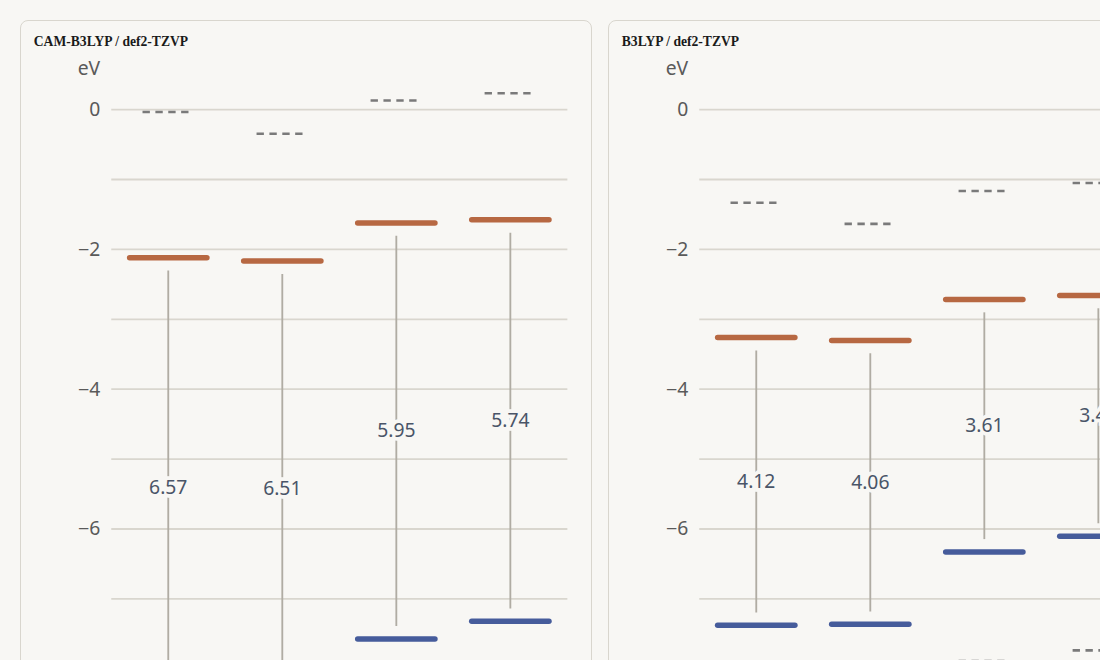
How the donor closes the gap: para-substituent effects in a minimal push-pull dye
A four-point series of para-X-benzylidenemalononitriles (X = H, F, NH₂, NMe₂) shows how donor strength moves the HOMO and LUMO, and explains why para-fluorine acts as a weak net donor in this minimal push-pull scaffold.
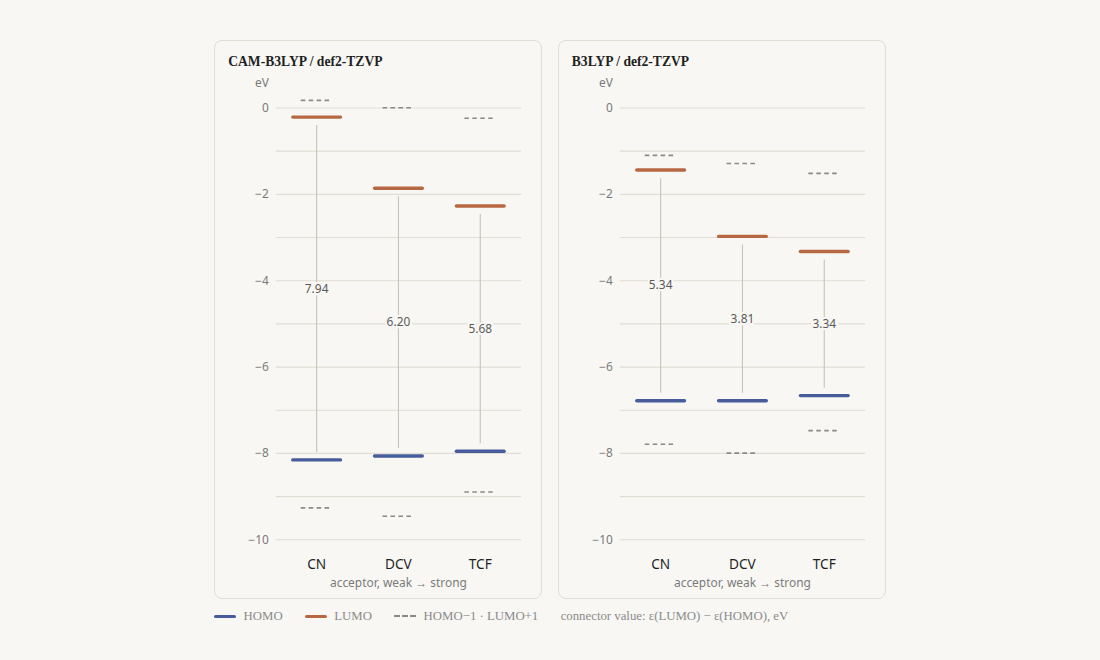
How the acceptor closes the gap: acceptor-strength effects in para-methoxy push-pull dyes
A three-point series of para-methoxy push-pull dyes with CN, DCV, and TCF acceptors shows how acceptor strength moves the HOMO and LUMO, and how the HOMO-LUMO gap closes as the acceptor strengthens.
One dye, one transition: how DCDHF-Me2 earns the two-level picture
The blinking-to-absorption note modeled a fluorescent dye as two levels and named what that hides. Computing the actual excited-state manifold of DCDHF-Me2 — a push-pull dye engineered for single-molecule imaging — gives a sharper answer than we planned. Its visible absorption is essentially one transition, and the rest of the manifold lives in the deep UV; benzene, the dye's own parent ring, shows the opposite arrangement for a reason symmetry makes plain.
One donor, one acceptor, one new band: push–pull chromophores and charge transfer
Aniline and nitrobenzene each absorb only in the ultraviolet. Bolt the amino donor and the nitro acceptor onto the same ring and a new band appears that neither parent owns — lower in energy and brighter than anything either shows alone. This post computes that emergence with TD-DFT, measures the charge-transfer character directly, and uses it to stress-test two density functionals against a failure mode one of them is famous for.
AI Assisted Computational Tools for TDDFT Analysis of Chromophores Supplemental Information
A suite of Python-based computational tools for efficient geometry optimization, TD-DFT calculations, and spectral visualization of chromophores, providing a systematic approach to predicting electronic transitions and optical properties.
AI Assisted Computational Tools for Time-Dependent Density Functional Theory Analysis of Chromophores
A suite of Python-based computational tools for efficient geometry optimization, TD-DFT calculations, and spectral visualization of chromophores, providing a systematic approach to predicting electronic transitions and optical properties.
Mathematical Frameworks and Basis Sets in Excited State Calculations
A comprehensive explanation of the mathematical principles underlying excited state calculations, including TD-DFT, EOM-CCSD, ADC, and CASSCF methodologies, as well as detailed discussions on basis set selection, computational considerations, and practical applications.
Comparative Analysis of TD-DFT Functionals for Formaldehyde Excited States
A systematic comparison of different DFT functionals for predicting formaldehyde excited states, revealing significant variations in excitation energies and oscillator strengths across methods.