
When pulse-independent trajectories lose nuclear accuracy: testing Galiana et al.'s open regime
Abstract
Galiana et al.’s 2026 paper, Accounting for Electronic Coherences Induced by Broadband Pulses by Using Pulse-Independent Trajectories, proposes separating an expensive nuclear simulation from the broadband pulse that prepares its electronic state.1 Their published glycine test is favorable: more than 90% of its surface hops occur after the initial electronic coherences have almost disappeared. I independently tested the complementary regime on a two-state, two-mode conical-intersection model. Full propagation (FP) and electronic repropagation on an all-excited-state ensemble (RP-AXE) used matched Wigner samples, four seeds, 4,000 geometries per seed, and the projected-forces-and- momenta decoherence correction. Moving the packet toward the intersection raised the fraction of successful hops occurring before the coherence fell to \(1/e\) from 7.30% to 26.13%. Across five predeclared launch positions, that fraction had Spearman correlation \(\rho=0.90\) with each maximum FP–RP error. The nuclear-centroid difference crossed its predeclared \(0.1\sigma_x\) tolerance at a 19.98% early-hop fraction; the upper-state and product-side population differences remained below 0.05 throughout. Exact grid dynamics sharpened the split: RP-AXE had the lower electronic-population RMSE in all nine tested regimes, while FP had the lower product probability and centroid RMSE in all nine. The preregistered center scan supports the hypothesis over its reached 7.30–26.13% range; the adaptive kick extension reached 26.29% without changing the qualitative result. The predeclared high-overlap test remains inconclusive, because neither translating nor directionally kicking the packet produced the required 50% early-hop fraction. Population agreement alone can therefore overstate the quality of reused nuclear trajectories before their ultimate validity boundary has been located.
Introduction
Predictive photoinduced-dynamics simulations have to couple electronic and nuclear motion without making a realistic molecule computationally inaccessible. Exact wavepacket methods retain nuclear quantum effects but scale poorly with dimensionality; trajectory surface hopping (TSH) scales much more gently but replaces the nuclear wavepacket by an ensemble of classical paths and requires an approximate treatment of decoherence.2,3 Broadband pulses add another dependency. The pulse can prepare a coherent superposition of electronic states, so changing its frequency, bandwidth, or polarization can change both the electronic coefficients and the nuclear forces from the first time step.
Grell and co-workers introduced the projected forces and momenta method with momentum injection, TSH-PFMi, to damp electronic coherence from estimates of the separating nuclear-wavepacket momenta and forces.4 In Accounting for Electronic Coherences Induced by Broadband Pulses by Using Pulse-Independent Trajectories, Galiana and co-workers then proposed a way to reuse the expensive part of that calculation. Their RP-AXE construction first generates an all-excited-state ensemble of nuclear trajectories without pump-generated coherence. For each new pulse, it repropagates the inexpensive electronic coefficients along those frozen paths and combines the active-state branches with pulse-dependent weights.1 A 2026 extension uses that construction to scan pulse parameters without recalculating the glycine trajectories.5
The approximation has a clearly stated seam. Repropagation is exact when no surface hops occur, since changing the electronic coefficients cannot then change the active potential or nuclear path. It remains plausible when hops occur after the initial coherence has decayed. In Galiana and co-workers’ three-state glycine calculation, more than 90% of the hops occurred after 3 fs, when two relevant coherences were already almost gone. The authors explicitly left wavepackets prepared at or close to a conical intersection for further testing, since there the active surface may change while the initial coherence still affects the forces.1
That open regime suggests a measurable control variable: the fraction of successful FP hops that occur before the initial coherence falls to \(1/e\). Hypothesis. FP–RP errors in electronic population, product-side nuclear probability, and nuclear centroid will increase as this early-hop fraction increases. The predeclared high-overlap test required a regime with at least half of all successful hops before the \(1/e\) time. RP-AXE would count as robust there only if its maximum FP differences remained at or below 0.05 in both populations and \(0.1\sigma_x\) in the centroid. Falsifier. The hypothesis would be rejected if all three limits held at an early-hop fraction of at least 0.5, or if the five-position scan had no positive association between the early-hop fraction and error. I would publish that result too: it would extend the safe operating range of pulse-independent trajectories into precisely the regime that their source paper left open.
Computational Methods
The calculations ran on arm64 macOS 26.5.2 with CPython 3.13.12 and NumPy 2.4.4. The implementation and analysis use NumPy and the Python standard library. The complete scripts, raw outputs, compact analysis, figures, and rerun instructions are in pulse-independent-ci-data.tar.gz. The preregistration, including a pilot-triggered extension recorded before its data were generated, is preserved in the repository’s question ledger.
Model and exact dynamics
I used the effective two-dimensional linear-vibronic-coupling model for the bis(methylene) adamantyl cation, BMA[5,5], employed by Mannouch and Kelly and derived from the conical-intersection model of Ryabinkin, Joubert-Doriol, and Izmaylov.6,7 In mass-weighted atomic units its diabatic Hamiltonian is
\[ \hat H = \frac{\hat p_x^2+\hat p_y^2}{2} + \frac{\omega_x^2q_x^2+\omega_y^2q_y^2}{2}\mathbf 1 + \begin{pmatrix} -\kappa(q_x) & c q_y\\ c q_y & \kappa(q_x) \end{pmatrix}, \qquad \kappa(q_x)=\frac{\omega_x^2 a q_x}{2}, \]
with \(\omega_x=7.743\times10^{-3}\), \(\omega_y=6.68\times10^{-3}\), \(a=31.05\), and \(c=8.092\times10^{-5}\). The published coherent initial electronic state was \(\sqrt{0.8}\,|\psi_1\rangle+\sqrt{0.2}\,|\psi_2\rangle\). Its nuclear factor was a minimum-uncertainty Gaussian with the published widths, initially centered at \((q_x,q_y)=(a/2,0)\) and with zero mean momentum.
The exact solver used second-order split-operator propagation on periodic Fourier grids in the global diabatic basis. Before the trajectory sweep, I compared the BMA upper-adiabatic population with the exact curve digitized at integer femtoseconds from the vector artwork of Mannouch and Kelly Figure 6. The digitized line is roughly 0.003 population units thick, so it is a figure-level check rather than a surrogate data table. BMA convergence used \(256^2\), \(384^2\), and \(512^2\) grids over \([-96,96)^2\), with 0.05 and 0.025 fs steps through 40 fs. A separate one-dimensional coherent avoided-crossing model from the same article checked the reported stationary/moving nuclear- density bifurcation on 2,048- and 4,096-point grids over \([-8,8)\) through 200 fs.6
Exact references for the new regimes used a \(384^2\) BMA grid (\(\Delta q=0.5\)), a 0.025 fs step, and output every 0.025 fs through 20 fs. The launch-position scan retained the published widths, momentum distribution, electronic state, and Hamiltonian while changing \(q_{x,0}/(a/2)\) through \(1,0.75,0.5,0.25,\) and \(0\). The second-stage scan held \(q_{x,0}/(a/2)=0.5\) and added mean momentum toward the intersection at \(0,-0.5,-1,-1.5,\) and \(-2\) times the Wigner \(p_x\) standard deviation. During the drafting audit, I added two post hoc \(512^2\) checks at the most displaced center (\(q_{x,0}=0\)) and the strongest directional kick. They test the production reference grid outside the original packet center; they were not part of the preregistered trajectory hypothesis.
Full and pulse-independent trajectories
Each regime used four predeclared seeds, 1701–1704, and 4,000 matched Wigner geometries and momenta per seed. The FP ensemble started every trajectory in the coherent electronic state and sampled its initial active adiabat from the geometry-dependent adiabatic populations. The AXE ensemble created two paths per geometry, one on each pure active adiabat. The coherent electronic coefficients were then propagated along both AXE paths without feeding back into their coordinates, and the two branches were weighted by their geometry-dependent initial populations. This is an independent implementation of RP-AXE, not a call to the authors’ program.1
Nuclei were advanced with velocity Verlet. Electronic coefficients were advanced analytically in the diabatic basis; density-flux hopping probabilities were evaluated in the adiabatic basis; accepted hops used isotropic momentum rescaling. Both FP and AXE paths used TSH-PFMi with \(\omega=\sqrt{\omega_x\omega_y}=0.0071918871\), inactive-population threshold \(\eta=10^{-4}\), and the published momentum-injection procedure.4 The predeclared 0.05 fs/five-substep setting was compared at \(q_{x,0}/(a/2)=0.25\) with 0.025 fs and ten electronic substeps using seed 1701 and 4,000 geometries. Its centroid criterion failed, so every final trajectory used the finer 0.025 fs nuclear step and ten 0.0025 fs electronic substeps.
For FP I recorded the coefficient-based upper-adiabatic population, the coherence amplitude
\[ C(t)=\left\langle 2|c_-^*(t)c_+(t)|\right\rangle, \]
the nuclear centroid \(\langle q_x\rangle\), and the fixed-side probability \(P(q_x<0)\). The coherence lifetime is the first interpolated crossing of \(C(0)/e\); the early-hop fraction includes accepted FP hops at or before that time and excludes frustrated hops. Primary errors are maximum-in-time absolute FP–RP differences. Centroid errors are divided by the published initial \(\sigma_x=[2\omega_x]^{-1/2}\). Spearman correlations are descriptive across the five predeclared centers. The kick scan is labeled adaptive and was not substituted for the original test.
I did not run the authors’ locally modified SHARC code, their glycine trajectories, or their electronic-structure data. No public implementation of their RP-AXE workflow was used. Results below are for this independently coded BMA stress test and do not reproduce the glycine calculation.
Results
The published-model gate returned passed: true. On the finest BMA grid, the
upper-population RMSE against the digitized Figure 6 curve was 0.002653 and the
maximum absolute difference was 0.009552 (Figure 1). The \(384^2\)/0.025 fs and
\(512^2\)/0.025 fs BMA runs differed by \(7.06\times10^{-6}\) in upper population,
\(9.96\times10^{-4}\) in \(P(q_x<0)\), and \(3.98\times10^{-9}\) in centroid over
40 fs. Their maximum norm errors were \(9.96\times10^{-14}\) and
\(3.88\times10^{-13}\).
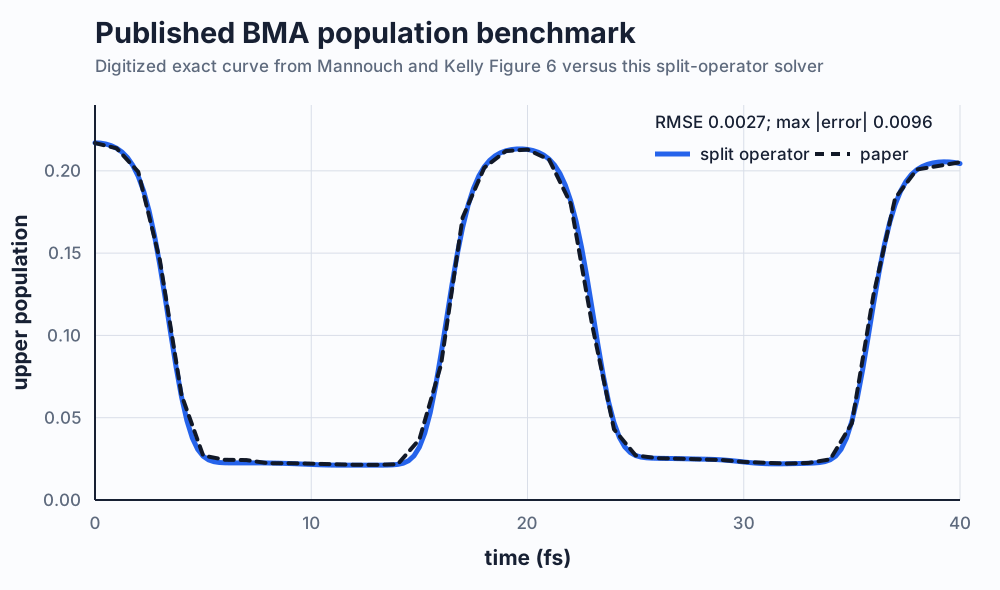
Figure 1. Upper-adiabatic BMA population from the \(512^2\), 0.025 fs split-operator run and the digitized exact curve from Mannouch and Kelly Figure 6.6
At 200 fs, the finest one-dimensional calculation placed 0.971077 of the nuclear probability in \(q<-1.5\) and 0.023396 in \(q>-1\), the two regions used to integrate the stationary and moving density branches. The 2,048- and 4,096-point runs at 0.05 fs differed by \(3.88\times10^{-5}\) and \(7.38\times10^{-6}\) in those branch probabilities. Their upper populations differed by \(7.87\times10^{-14}\).
The trajectory time-step comparison returned maximum coarse–fine differences of 0.00776 in FP upper population, 0.00825 in FP product probability, and \(0.03837\sigma_x\) in the FP centroid. The corresponding RP values were 0.00328, 0.00585, and \(0.00863\sigma_x\). The stored population and product flags were true; the \(0.03\sigma_x\) centroid flag and aggregate gate were false. The final sweep contains 36 fine-setting replicates: nine distinct regimes, four seeds per regime, and 4,000 geometries per seed.
Table 1 gives the pooled FP–RP values for the predeclared center scan. The coherence lifetime ranged from 2.164 to 2.634 fs. The early-hop fraction ranged from 0.0730 to 0.2613. Its Spearman correlation with each of the three maximum errors was 0.90. The maximum coherence-amplitude difference rose from 0.00295 to 0.00664 and had \(\rho=1.00\) with the early-hop fraction.
Table 1. FP–RP-AXE maximum absolute differences for the four-seed pooled center scan. Each regime contains 16,000 FP trajectories and 32,000 AXE paths.
| \(q_{x,0}/(a/2)\) | \(C(0)/e\) time (fs) | early hops | max \(|\Delta P_+|\) | max \(|\Delta P(q_x<0)|\) | max \(|\Delta\langle q_x\rangle|/\sigma_x\) |
|---|---|---|---|---|---|
| 1.00 | 2.164 | 0.0730 | 0.00495 | 0.01077 | 0.06487 |
| 0.75 | 2.265 | 0.1286 | 0.01096 | 0.01187 | 0.08233 |
| 0.50 | 2.396 | 0.1998 | 0.02019 | 0.01436 | 0.10381 |
| 0.25 | 2.536 | 0.2451 | 0.01912 | 0.01772 | 0.12773 |
| 0.00 | 2.634 | 0.2613 | 0.02186 | 0.01627 | 0.10725 |
Figure 2 divides each maximum error by its predeclared tolerance. The centroid ratios were 0.649, 0.823, 1.038, 1.277, and 1.072 across the center scan. The largest population and product ratios within that scan were 0.437 and 0.355.
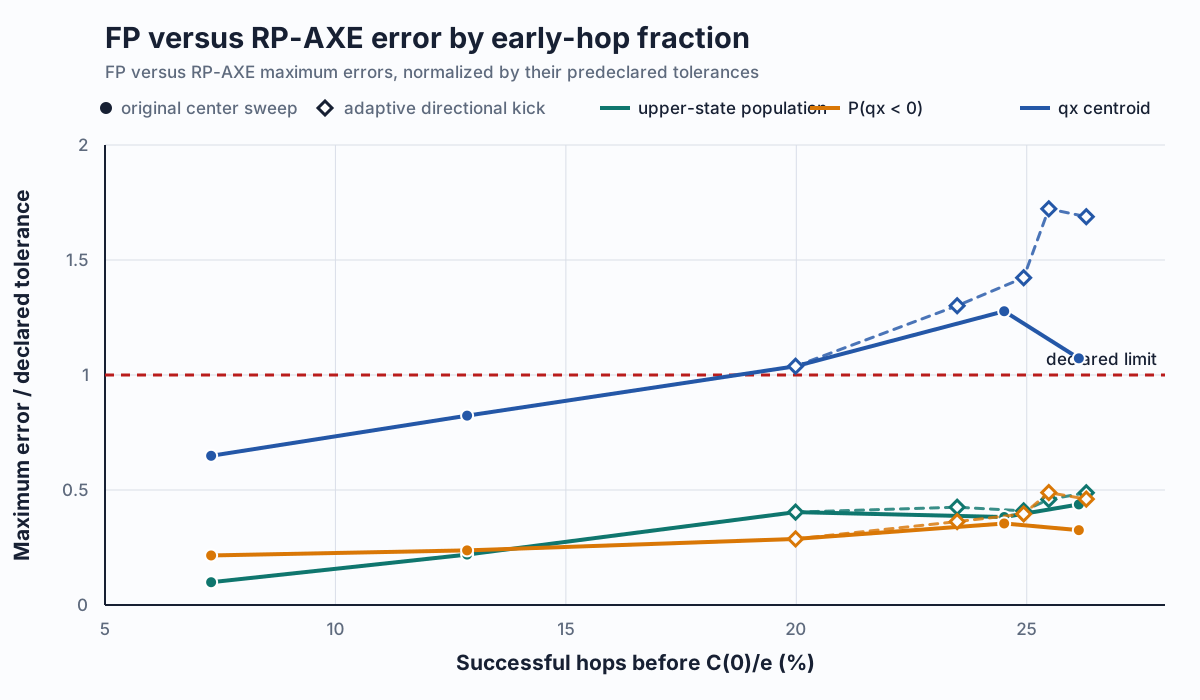
Figure 2. Maximum FP–RP-AXE differences divided by the predeclared limits of 0.05 for upper population, 0.05 for \(P(q_x<0)\), and \(0.1\sigma_x\) for the centroid. Solid circles are the original center scan; open diamonds are the adaptive directional-kick scan.
Table 2 lists the adaptive scan at center fraction 0.5. From zero to a \(-2\sigma_{p_x}\) kick, the coherence lifetime changed from 2.396 to 2.127 fs, the number of accepted FP hops increased from 11,865 to 23,772, and the early-hop fraction increased from 0.1998 to 0.2629. The early-hop correlations with population, product, and centroid errors were 0.90; the correlation with maximum coherence-amplitude error was 1.00. No regime in either scan had an early-hop fraction of 0.5.
Table 2. FP–RP-AXE maximum absolute differences in the adaptive directional-kick scan.
| \(-\langle p_x\rangle/\sigma_{p_x}\) | early hops | max \(|\Delta P_+|\) | max \(|\Delta P(q_x<0)|\) | max \(|\Delta\langle q_x\rangle|/\sigma_x\) |
|---|---|---|---|---|
| 0.0 | 0.1998 | 0.02019 | 0.01436 | 0.10381 |
| 0.5 | 0.2349 | 0.02126 | 0.01813 | 0.13011 |
| 1.0 | 0.2493 | 0.02047 | 0.01979 | 0.14228 |
| 1.5 | 0.2548 | 0.02295 | 0.02444 | 0.17224 |
| 2.0 | 0.2629 | 0.02440 | 0.02302 | 0.16882 |
Against exact grid dynamics, RP-AXE had the lower upper-population RMSE in 9 of 9 regimes. FP had the lower \(P(q_x<0)\) RMSE in 9 of 9 and the lower centroid RMSE in 9 of 9. At center fraction 0.5 without a kick, the upper-population RMSEs were 0.02765 for FP and 0.01946 for RP-AXE; product RMSEs were 0.01902 and 0.02639; centroid RMSEs were \(0.06361\sigma_x\) and \(0.12582\sigma_x\). At the strongest \(-2\sigma_{p_x}\) kick, FP’s product and centroid RMSEs were 0.0492 and \(0.247\sigma_x\), respectively. Figure 3 plots the two time series used for the population and centroid entries. Across the nine exact runs, the maximum norm error was \(6.28\times10^{-14}\). In the separate per-seed comparison, RP-AXE had the lower population RMSE in 36/36 replicates; FP had the lower product RMSE in 35/36 and the lower centroid RMSE in 36/36. The post hoc \(384^2\)–\(512^2\) spot checks returned maximum population differences of \(6.96\times10^{-6}\) and \(1.24\times10^{-5}\), product-side differences of 0.00310 and 0.00305, and centroid differences below \(3.4\times10^{-11}\sigma_x\) for the zero-center and strongest-kick regimes, respectively.
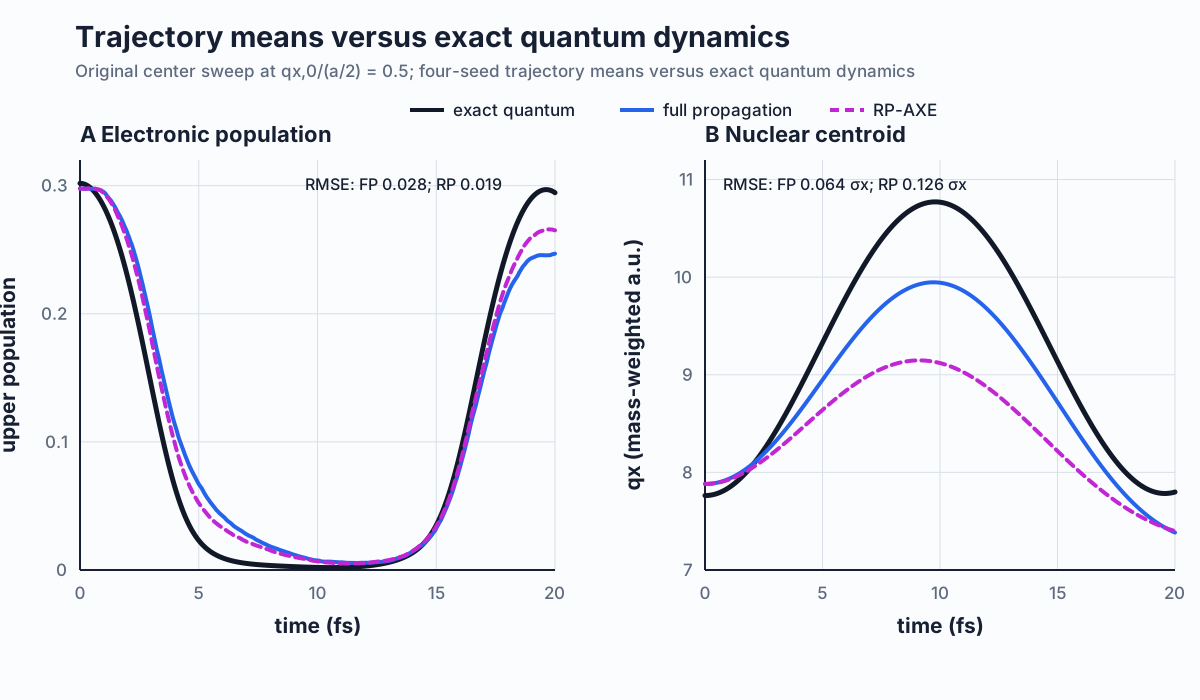
Figure 3. Exact, FP, and RP-AXE upper population and nuclear centroid for \(q_{x,0}/(a/2)=0.5\) with zero mean momentum. RMSE annotations use the full 20 fs series; centroid RMSE is in units of the initial \(\sigma_x\).
Over all trajectory replicates, the maximum electronic norm error was \(1.44\times10^{-15}\), the maximum AXE weight-normalization error was \(1.11\times10^{-16}\), and the largest recorded energy drifts were \(5.63\times10^{-4}\ E_h\) for FP and \(6.06\times10^{-4}\ E_h\) for AXE. The largest difference between coefficient population and active-surface fraction was 0.01943.
Discussion
Verdict: the hypothesis is supported over the reached range, while its predeclared high-overlap test is inconclusive. In the original five-center scan, all three FP–RP errors had a positive Spearman association of 0.90 with the fraction of hops occurring before the coherence lifetime. The nuclear-centroid error crossed its declared \(0.1\sigma_x\) limit at a 19.98% early-hop fraction, whereas neither population error approached its 0.05 limit. The experiment did not produce the required 50% early-hop regime, so it cannot adjudicate the other half of the falsifier or claim an ultimate breakdown point.
The exact references reveal why the observable choice changes the verdict. At the central regime in Figure 3, selecting by electronic population alone would prefer RP-AXE: its RMSE is 30% lower than FP’s. The same reused paths have a product-probability RMSE 39% higher and a centroid RMSE 98% higher than FP. That ordering persists in all nine regimes. This is consistent with error cancellation in an electronic marginal: changing the nuclear paths can move a surface-hopping population toward the exact curve even while moving nuclear observables away from it. It is not evidence that FP is exact. In the strongest \(-2\sigma_{p_x}\) kick, the FP errors reported above are already substantial against the grid reference.
The distinction answers the source paper’s open question without contradicting its reported glycine result. Galiana and co-workers tested a regime in which more than 90% of hops arrived after 3 fs and concluded that the small number of hops during surviving pump-generated coherence made repropagation a good approximation.1 Here the measured error begins to appear as that timing overlap grows. Their electronic populations and dipoles were the appropriate observables for their spectroscopy calculation; this stress test adds a warning for control studies whose objective depends on a nuclear coordinate, side probability, or branching outcome.
The adaptive kick also explains why the planned boundary was harder to reach than moving a packet toward the intersection might suggest. Increasing the kick nearly doubled the accepted-hop count, but it shortened the \(1/e\) coherence lifetime from 2.396 to 2.127 fs and added later hops to the denominator. The early-hop fraction consequently saturated near 0.26. This second-stage scan reinforces the trend but does not repair the missing high-overlap regime; treating it as if it had reached 0.5 would relax the preregistration after seeing the data.
There are six boundaries on the result. First, the translated and kicked BMA packets are controlled stress tests, not pulse-prepared distributions for a specific molecule. Second, \(P(q_x<0)\) is a fixed-side nuclear observable, not a chemically resolved product yield. Third, the four seeds quantify stochastic TSH variation but the five center values provide a small descriptive correlation scan. Fourth, the exact comparison includes every approximation in the independent TSH-PFMi implementation, including classical nuclei and the absence of nuclear geometric-phase interference near the conical intersection.7 The paired FP–RP comparison is more specific to trajectory reuse because those approximations are shared. Fifth, the authors’ modified SHARC implementation and glycine data were not available in this experiment; agreement or disagreement with this code is not a software-level reproduction. Sixth, AXE uses both initial active-state paths for every geometry while FP samples one, so the exact-RMSE rankings compare the two methods as defined rather than equal nuclear-path counts. The 36/36 per-seed electronic ordering is less consistent with a chance seed fluctuation, but it does not isolate the effect of that larger AXE ensemble.
Within those limits, the practical validation rule is simple: a pulse-independent method should not be cleared by electronic populations alone. At minimum, validation should include the nuclear observable that the control problem is trying to optimize, and it should report how much surface hopping occurs before the prepared coherence decays. In this model, the first declared failure appears in the nuclei while the electronic trace still looks better against exact dynamics.
Conclusion
Pulse-independent trajectory reuse now has a measured onset rather than a binary label in this model: nuclear-centroid error exceeds its declared limit near a 20% early-hop fraction, while electronic and side-population errors stay below theirs through 26%. The remaining boundary is deliberately unresolved.
The next experiment should change the coupling topology or coherence lifetime, instead of pushing the packet faster, to create a majority of hops before \(C(0)/e\) without simultaneously swelling the late-hop denominator. Repeating the FP–RP–exact comparison there would adjudicate the predeclared 50% test; running the same observable set in the authors’ molecular implementation would then determine whether the BMA ordering transfers beyond this model.